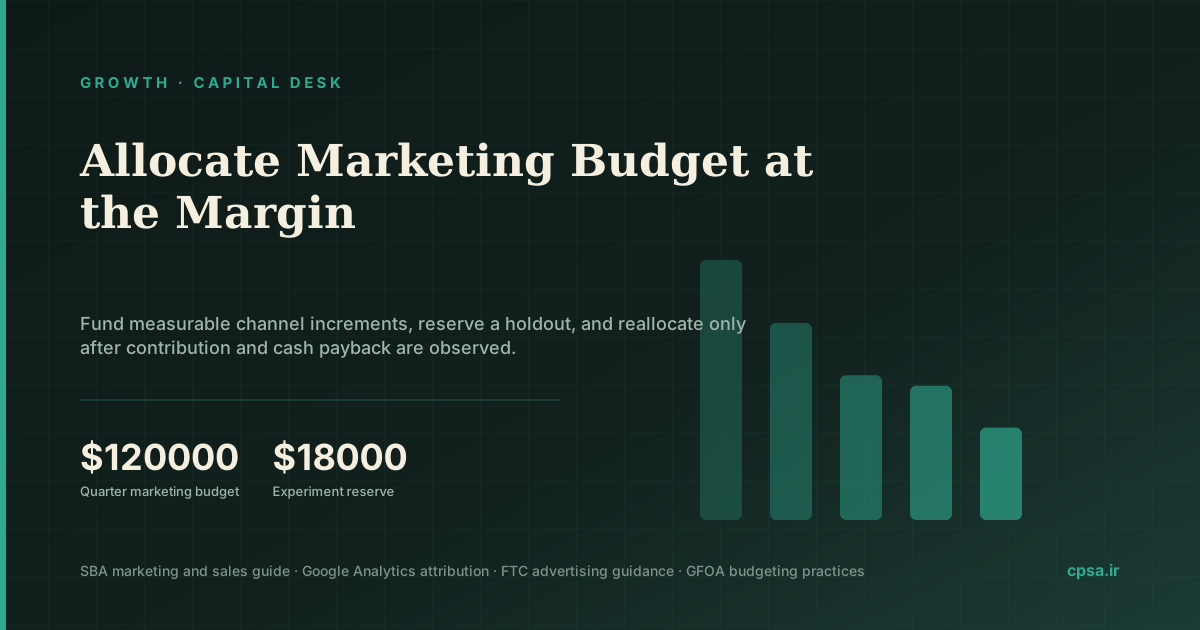
A marketing budget is a portfolio of testable cash commitments, not a percentage of revenue copied from another company. Allocate the next unit of spend according to incremental contribution, evidence quality, capacity, and payback before the cash constraint.
Set the economic and cash boundary
Start with contribution per acquired customer, expected collection dates, fulfillment capacity, and the latest acceptable payback month. Separate committed contracts from cancellable tranches so a downside signal can still change cash outflow.
Do not derive spend from a generic revenue percentage. SBA planning guidance supports connecting tactics to target markets and goals; the finance layer must add unit contribution, cash timing, and an owner for every release gate.
Build a tranche allocation
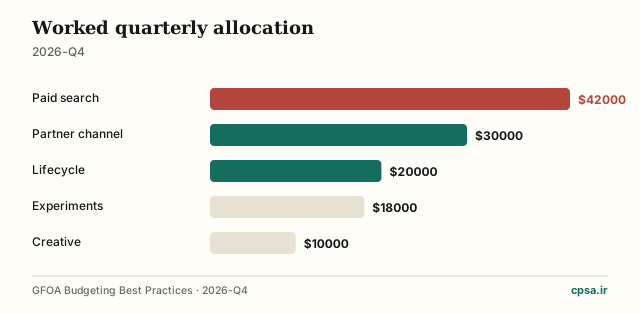
Worked Q4 2026 example in nominal USD: total cash authorization is USD 120,000. Reserve USD 18,000 for controlled experiments, then allocate USD 42,000 to paid search, USD 30,000 to partners, USD 20,000 to lifecycle, and USD 10,000 to creative production. The five amounts reconcile to USD 120,000.
Artifact: keep a release register with channel, tranche amount, start date, attribution rule, holdout, qualified-customer count, collected contribution, stop date, and approver. Assumptions are no tax, USD transaction currency, sufficient delivery capacity, and no overlap between the labeled channel cohorts.
- Paid search42,000 $
- Partner channel30,000 $
- Lifecycle20,000 $
- Experiments18,000 $
- Creative10,000 $
GFOA Budgeting Best Practices (2026-Q4). Worked allocation, not an industry mix recommendation.
Measure incrementality before reallocation
Platform attribution describes a rule for assigning credit; it does not prove the conversion would not have happened otherwise. Use geographic, audience, or time holdouts where feasible, preserve the predeclared window, and reconcile attributed customers to contracts and cash receipts.
If monthly collected contribution is USD 180, the cash limit is four months, and a 20% safety buffer is required, funded CAC ceiling is 180 × 4 / 1.2 = USD 600. Sensitivity: at USD 140 contribution the same ceiling falls to USD 467; pause the next tranche rather than averaging away the decline.
Control claims, currency, and jurisdiction
FTC rules require truthful, substantiated advertising and clear disclosures in the United States. Endorsements, discounts, renewal claims, privacy consent, and sector restrictions differ elsewhere; legal review must follow the audience and media jurisdictions, not merely the company's incorporation.
Preserve invoice currency and date every consolidation rate. For a rial business buying foreign media, test both media-price and exchange-rate shocks separately; the example above is nominal USD and excludes VAT, withholding, agency fees, and local tax, which require jurisdiction-specific advice.
Frequently asked questions
How often should allocation change?
At a predeclared review cadence or when a stop gate breaks, not after every noisy day.
Is platform ROAS enough?
No. Reconcile attribution to incremental customers, contribution, and collected cash.
Why reserve experiment money?
It prevents mature channels from consuming all learning capacity; the percentage is a governance choice.
Are advertising taxes included?
No. The worked case excludes taxes and requires local tax and legal review.
Answers to the questions this topic usually leaves hanging.
How we sourced this
Every statistic in Allocate Marketing Budget at the Margin is attributed. Where a number is an estimate rather than a census, the note says so.
- SBA marketing and sales guideMarket, plan, and sales foundations.
- Google Analytics attributionDefinitions and limits of attribution models.
- FTC advertising guidanceTruthfulness, substantiation, and disclosure requirements.
- GFOA budgeting practicesBudget authorization and monitoring principles.
Primary sources used for this edition.
The bottom line
Release one channel tranche only after its measurement rule and stop date are written.
If you want the adjacent decisions after Allocate Marketing Budget at the Margin, start with CAC optimization, LTV calculation, Startup budget, Financial reporting.