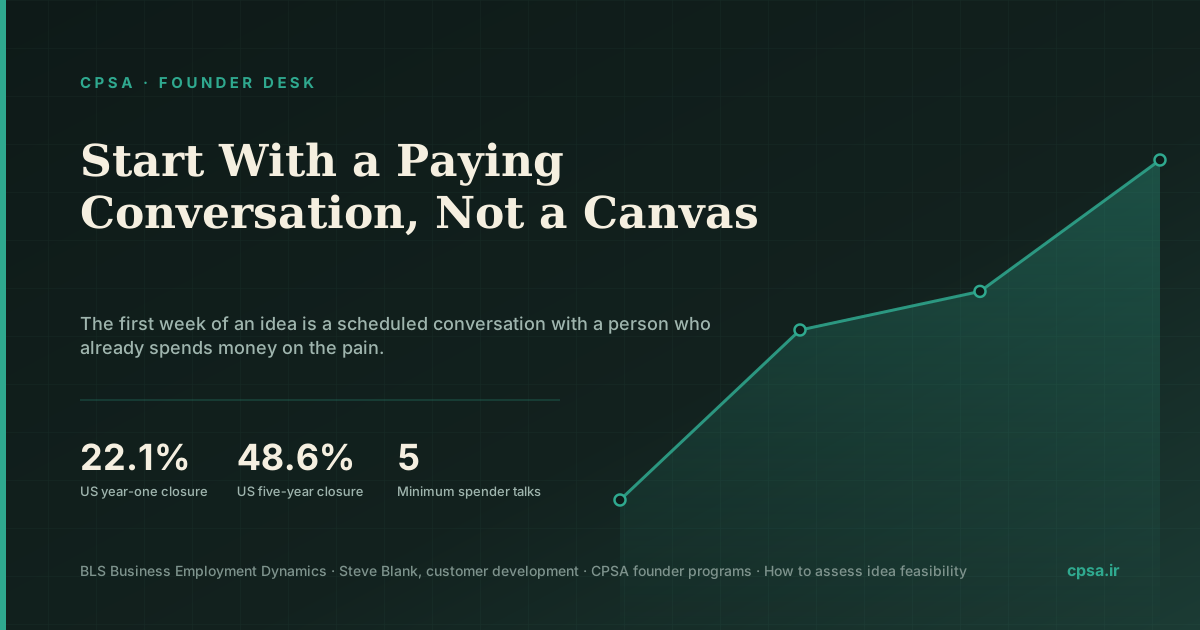
Most idea advice starts with a canvas because canvases are quiet. The useful first week is noisy: find someone who already pays to make the pain go away, ask what they bought last time, and write an offer they can refuse by Friday. BLS survival tables show about one in five new US establishments close in year one. An untested canvas does not change that math.
Find a spender, not a cheerleader
A friend who likes the idea is not evidence. A person who already has a vendor, a workaround, or a budget line for the pain is evidence. Write five names this week. If you cannot name five spenders, you do not yet have a customer; you have a theme.
Separate the user from the buyer. A nurse may feel the scheduling pain while a clinic manager controls the budget; praise from the nurse cannot substitute for a priced response from the manager. Record both roles beside every name.
The Friday refusal test
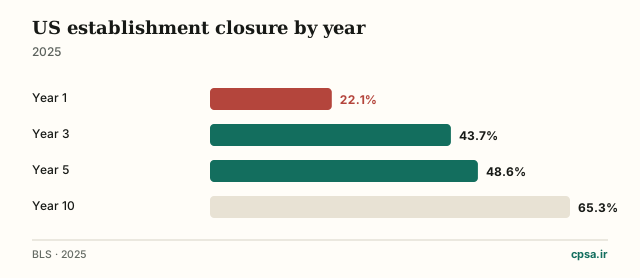
Offer a priced next step: a paid pilot, a deposit, or a purchase order draft. If nobody can refuse you by Friday, you did not make an offer. You made a conversation. BLS’s 22.1% year-one closure — a US establishment rate, not an Iranian census — is what happens when firms stay untested.
A refusal must name the obstacle: price, authority, timing, trust, or no pain. “Interesting, keep me posted” is neither acceptance nor useful rejection. Ask what would have to change for a signed pilot, then date that condition.
- Year 122.1%
- Year 343.7%
- Year 548.6%
- Year 1065.3%
BLS (2025). US establishment closure by tenure, BLS BED.
Worked first week in Mashhad
A founder wants a clinic no-show tool. Week one is not a lean canvas. It is five clinic managers who already pay a secretary to call patients, a one-page offer at a monthly price, and a dated yes or no. If three managers say the secretary is cheaper, the idea just paid for itself as a negative result.
A second founder proposes inventory alerts for small pharmacies. The useful observation is not that pharmacists dislike stockouts; it is which system they use now, who approves software spend, and whether one pharmacy will pay for a short trial. If access to that approver is impossible, distribution—not product design—is the first failed assumption.
When a canvas is allowed
Draw the canvas after you have one priced reaction. Use it to list what you will not build. Do not use it to postpone the call. Feasibility work lives on how-to-assess-feasibility-of-your-idea once a spender exists.
The canvas may organize evidence, but blank boxes are not hypotheses proved. Put a buyer quote, a substitute invoice, or a dated refusal beside each important box; leave unsupported boxes visibly unknown instead of filling them with confident prose.
Local constraints that change week one
If the spender pays in rial with delay, your first question is collections, not logo design. If the pain is illegal to invoice, stop. If the only buyer is a ministry with a twelve-month tender, your first week is a calendar, not a prototype.
Currency, procurement, licensing, and access are feasibility gates, not details for later. A technically workable product with no lawful invoice path or reachable buyer is a negative result worth learning before incorporation.
Frequently asked questions
Do I need a company before the conversations?
No. You need a name, an offer, and a way to take a deposit. Incorporation can wait for the first yes.
What if people will not take the meeting?
You do not have access to the spender. Find the person who already buys the workaround, or change the idea.
Is a survey enough?
No. Surveys collect politeness. A priced refusal is evidence.
How does the BLS number apply in Iran?
It is a US establishment survival curve, not an Iranian census. Use it as a reminder that untested firms die early everywhere.
Answers to the questions this topic usually leaves hanging.
How we sourced this
Every statistic in Start With a Paying Conversation, Not a Canvas is attributed. Where a number is an estimate rather than a census, the note says so.
- BLS Business Employment DynamicsEstablishment survival by tenure.
- Steve Blank, customer developmentThe paying-customer test as the first research act.
- CPSA founder programsAdjacent programs page; not the primary evidence for the five-conversation minimum.
- How to assess idea feasibilityAdjacent CPSA page for the second week.
Primary sources used for this edition.
The bottom line
Schedule the five conversations before you open a slide template.
If you want the adjacent decisions after Start With a Paying Conversation, Not a Canvas, start with Assess feasibility, Why startups fail, Market validation, Employee to founder.