Lifetime value is an estimate of economic contribution from a defined customer cohort. It is useful only when the observation window, churn definition, delivery costs, refunds, currency, and collection timing are disclosed.
Define the cohort before the formula
Group customers by acquisition month, product, channel, and contract currency. Record logo retention, revenue retention, refunds, failed collections, and expansion separately; a blended company average can combine customers with incompatible economics.
Choose the estimator before viewing the result. The reciprocal-churn shortcut assumes a stable hazard and no material expansion; a survival-curve model sums expected contribution in each future period and is preferable when early churn differs from mature churn.
Recompute a labeled cohort
Worked July 2026 example in nominal USD: monthly recognized revenue per account is USD 120, contribution margin after hosting, support, payment fees, and expected refunds is 60%, and monthly logo churn is 6%. Contribution is 120 × 60% = USD 72; simple LTV is 72 / 0.06 = USD 1,200.
Assumptions are constant churn, no expansion, no discounting, even service delivery, and no tax. With CAC of USD 360, payback is 360 / 72 = 5 months and LTV:CAC is 3.33. These are worked numbers, not a recommended target or claim about any population.
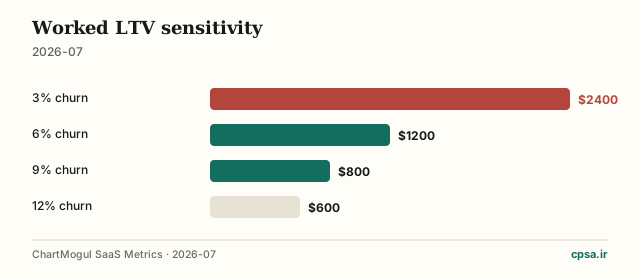
- 3% churn2,400 $
- 6% churn1,200 $
- 9% churn800 $
- 12% churn600 $
ChartMogul SaaS Metrics (2026-07). Worked nominal-USD cases, not market benchmarks.
Use sensitivity to choose retention work
Holding USD 72 contribution constant, monthly churn of 3%, 6%, 9%, and 12% produces shortcut LTVs of USD 2,400, 1,200, 800, and 600. The nonlinear result shows why a two-point churn change cannot be valued with a casual percentage uplift.
Use a retention experiment ledger: cohort, intervention, predeclared metric, observation window, incremental service cost, and confidence interval. FTC guidance also limits deceptive renewal and advertising practices; retention obtained through obscured cancellation is a compliance liability, not durable value.
Bridge recognized value to cash and jurisdiction
IFRS 15 governs when customer-contract revenue is recognized, while LTV needs economic contribution and collection probability. Keep deferred revenue, receivables, bad debt, and cash receipts distinct. If collection arrives 60 days late, disclose the delay and discount future cash when it is material.
For rial operations, retain each contract and cost in transaction currency and disclose the dated rate used for consolidation; test margin at a weaker exchange rate rather than translating a foreign benchmark. Revenue, consumer, tax, and privacy rules vary by jurisdiction, so local counsel and a licensed accountant must review policy consequences.
Frequently asked questions
Revenue LTV or contribution LTV?
Use contribution after incremental delivery, support, payment, refund, and collection costs.
Can I use one divided by churn?
Only as a disclosed shortcut when churn hazard is stable and expansion is immaterial.
How should annual prepayment enter LTV?
Separate invoice cash timing from monthly revenue recognition and service contribution.
Is this tax or accounting advice?
No. Apply the accounting and tax rules of the entity and contract jurisdictions with qualified advisers.
Answers to the questions this topic usually leaves hanging.
How we sourced this
Every statistic in LTV Begins With a Cohort and Ends With Collected Margin is attributed. Where a number is an estimate rather than a census, the note says so.
- ChartMogul SaaS metricsDefinitions for churn, LTV, and subscription metrics.
- Stripe revenue recognitionOperational distinction between billing and recognized revenue.
- IFRS Foundation — IFRS 15Authoritative customer-contract revenue principles.
- FTC advertising guidanceConsumer-protection limits for marketing and renewals.
Primary sources used for this edition.
The bottom line
Recalculate one acquisition cohort from invoices, delivery costs, refunds, and receipts before changing spend.
If you want the adjacent decisions after LTV Begins With a Cohort and Ends With Collected Margin, start with Unit economics, CAC optimization, Revenue recognition, Financial reporting.