A budget should authorize choices before money leaves, not explain them afterward. Connect every material line to a hiring date, contract, customer volume, or price so management can distinguish a bad assumption from poor execution.
Build from drivers and dates
Start with a monthly calendar. Payroll equals named roles multiplied by start dates, loaded compensation, and payment cadence. Cloud cost follows usage and contract tiers; marketing follows campaign dates; revenue follows units, price, and recognition policy.
Separate committed, planned, and contingent spending. A signed lease is committed; an approved but unsigned hire is planned; an experiment released only after a conversion gate is contingent. This classification makes cuts operational rather than arbitrary.
Reconcile budget to actual
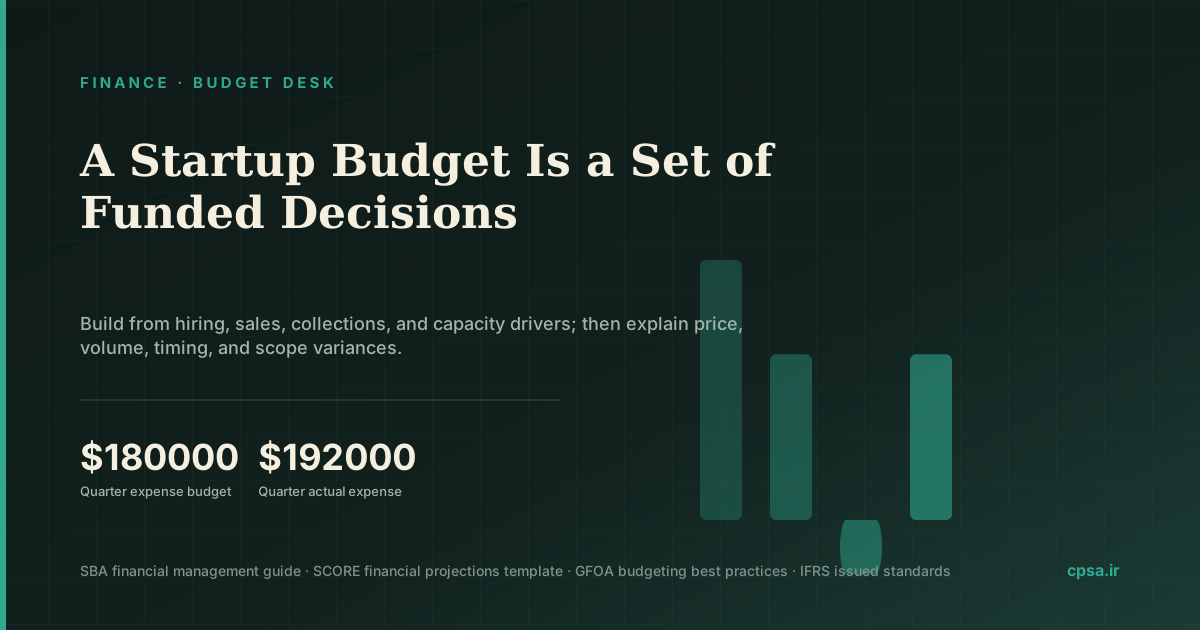
Worked Q3 2026 case in nominal USD: expense budget USD 180,000 and actual expense USD 192,000. Unfavorable variance is 192,000 - 180,000 = USD 12,000, or 12,000 / 180,000 = 6.7% after rounding.
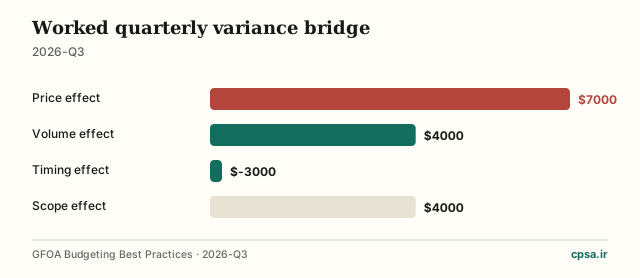
Bridge the USD 12,000 into USD 7,000 price, USD 4,000 volume, negative USD 3,000 timing, and USD 4,000 scope effects; the sum is USD 12,000. Assumptions: the ledger is closed, accruals are complete, classifications match, and no exchange translation is mixed into these causes.
- Price effect7,000 $
- Volume effect4,000 $
- Timing effect-3,000 $
- Scope effect4,000 $
GFOA Budgeting Best Practices (2026-Q3). Worked USD variance causes; not a spending benchmark.
Reforecast when assumptions break
Do not overwrite the approved budget. Preserve it as the accountability baseline, create a current forecast from actuals plus remaining commitments, and record which assumption changed, who approved it, and on what date.
Use explicit triggers: collection delay beyond fifteen days, hiring date movement beyond one month, price changes above five percent, or a capacity contract becoming committed. The thresholds are governance choices for this worked process, not universal benchmarks.
Budget currency and downside together
For a rial-led startup, budget payroll and domestic contracts in rial while preserving foreign software in invoice currency. State the dated conversion rate used for the consolidated view and show exchange variance separately from vendor-price and usage variance.
Sensitivity: if collections are 20% below plan but the USD 192,000 expense run-rate is unchanged, the response must be dated—delay a contingent hire, reduce campaign scope, or secure funding. A downside case without a decision trigger is only another spreadsheet column.
Frequently asked questions
Budget or forecast?
The budget is the approved baseline; the forecast is the latest expected outcome. Keep both.
How often should we reforecast?
Monthly, and immediately when a documented material trigger breaks.
Should unused budget carry forward?
Only after reapproval; an authorization for one period is not automatically cash for another.
How should FX variance appear?
Preserve invoice currency and isolate rate movement from price, volume, timing, and scope.
Answers to the questions this topic usually leaves hanging.
How we sourced this
Every statistic in A Startup Budget Is a Set of Funded Decisions is attributed. Where a number is an estimate rather than a census, the note says so.
- SBA financial management guideBudgeting, bookkeeping, and cash-flow fundamentals.
- SCORE financial projections templateStructured projection inputs and statements.
- GFOA budgeting best practicesBudget monitoring and governance principles.
- IFRS issued standardsAuthoritative accounting-policy reference for recognition and classification.
Primary sources used for this edition.
The bottom line
Freeze the approved baseline, close actuals, and assign an owner to every material assumption change.
If you want the adjacent decisions after A Startup Budget Is a Set of Funded Decisions, start with Cost structure, Financial modeling, Financial controls, Cash forecasting.