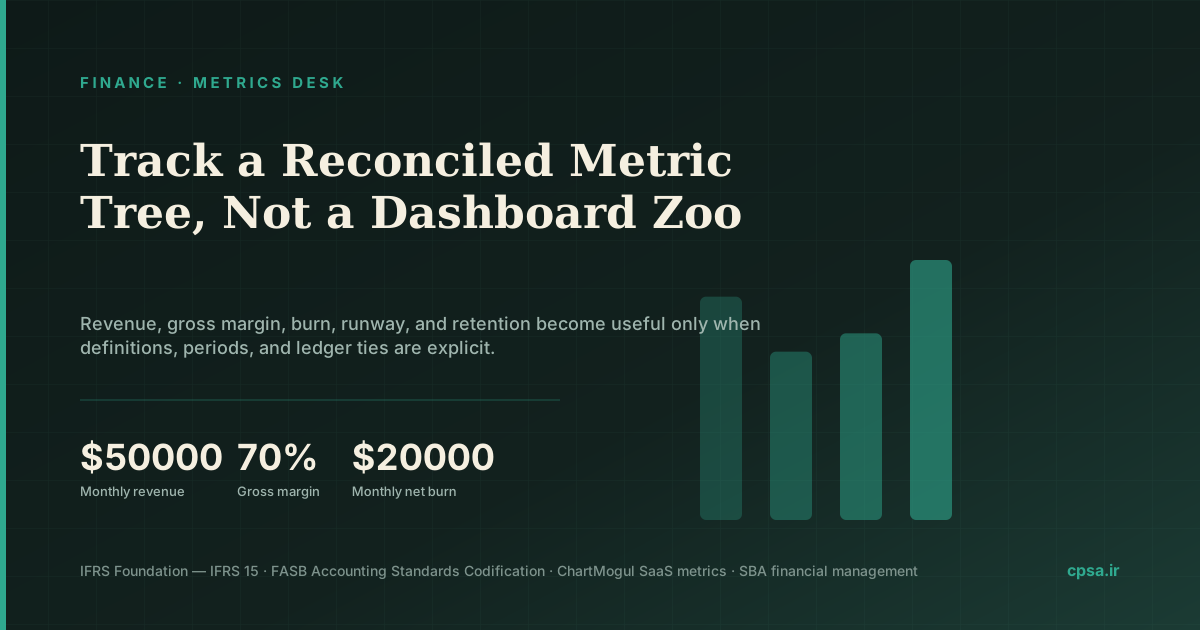
A metric deserves a weekly or monthly meeting only if its numerator and denominator can be reproduced. Start with recognized revenue and direct delivery cost, bridge operating cash, and explain customer movement; vanity counts do not fund payroll.
Define the metric tree
The first branch is performance: recognized revenue minus direct delivery cost equals gross profit; gross profit divided by revenue equals gross margin. IFRS 15 anchors revenue to satisfied performance obligations, not invoice date or cash arrival.
The second branch is liquidity: opening cash plus collections and financing minus payments equals closing cash. Net burn is operating cash out minus operating cash in for the period; runway is cash divided by a representative burn rate, with the averaging window disclosed.
Recompute one worked month
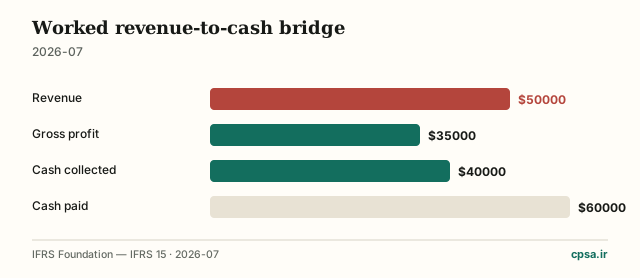
Worked case as of 31 July 2026 in nominal USD: revenue USD 50,000, direct delivery cost USD 15,000, gross profit USD 35,000, and gross margin 70%. Cash collections are USD 40,000 while operating payments are USD 60,000, so net burn is USD 20,000.
With USD 180,000 unrestricted cash, static runway is 180,000 / 20,000 = 9 months. Assumptions: no restricted deposits, financing excluded from operating inflow, taxes included in payments, no FX translation, and July burn represents the future; each assumption must appear beside the metric.
- Revenue50,000 $
- Gross profit35,000 $
- Cash collected40,000 $
- Cash paid60,000 $
IFRS Foundation — IFRS 15 (2026-07). Worked USD month; revenue and cash collections intentionally differ.
Explain customer movement
For recurring revenue, bridge beginning MRR through new, expansion, contraction, churn, and ending MRR. ChartMogul’s metric definitions help keep events distinct; use account-level event timestamps so the bridge can be reconciled instead of manually typed.
Do not force SaaS metrics onto a marketplace or services firm. A marketplace should reconcile gross merchandise value, take rate, refunds, and net revenue; services should track billable utilization, realized rate, backlog, and collection days.
Stress liquidity before celebrating growth
Sensitivity: if collections slip from USD 40,000 to USD 30,000 while payments stay USD 60,000, net burn becomes USD 30,000 and runway falls from 9 to 6 months. If delivery cost rises to USD 20,000, gross margin falls from 70% to 60%.
In a rial business with foreign-currency infrastructure, show operating movement in constant currency and translation impact separately. Date the exchange rate and preserve the original invoice currency; otherwise margin deterioration can be misreported as product inefficiency.
Frequently asked questions
Revenue or cash collected?
Track both. Revenue measures performance obligations; collections determine liquidity.
Gross burn or net burn?
Keep both definitions; runway usually uses net operating burn, with the chosen window disclosed.
Should financing count as revenue?
No. Financing changes cash and equity or debt, not customer revenue.
How often should metrics close?
Cash can update weekly; recognized revenue and margins should close monthly against the ledger.
Answers to the questions this topic usually leaves hanging.
How we sourced this
Every statistic in Track a Reconciled Metric Tree, Not a Dashboard Zoo is attributed. Where a number is an estimate rather than a census, the note says so.
- IFRS Foundation — IFRS 15Revenue recognition from customer contracts.
- FASB Accounting Standards CodificationAuthoritative US GAAP reference.
- ChartMogul SaaS metricsRecurring-revenue movement definitions.
- SBA financial managementCash-flow and financial-management fundamentals.
Primary sources used for this edition.
The bottom line
Delete any metric that cannot be reproduced from a record and a written definition.
If you want the adjacent decisions after Track a Reconciled Metric Tree, Not a Dashboard Zoo, start with Financial modeling, Budget management, Cost structure, Unit economics.