Revenue is recognized when control of promised goods or services transfers under the applicable accounting framework. Billing creates a receivable or cash claim; collection changes cash; neither event alone determines revenue.
Document the five-step analysis
Identify an enforceable customer contract, identify distinct performance obligations, determine transaction price including variable consideration and financing effects, allocate using relative standalone selling prices, and recognize as each obligation is satisfied. Store the conclusion beside the executed contract.
A setup activity is not automatically a separate obligation. Ask whether the customer benefits from it independently and whether the promise is distinct within the contract. Implementation that merely enables the hosted service may need recognition over the service period instead of day one.
Build the contract schedule
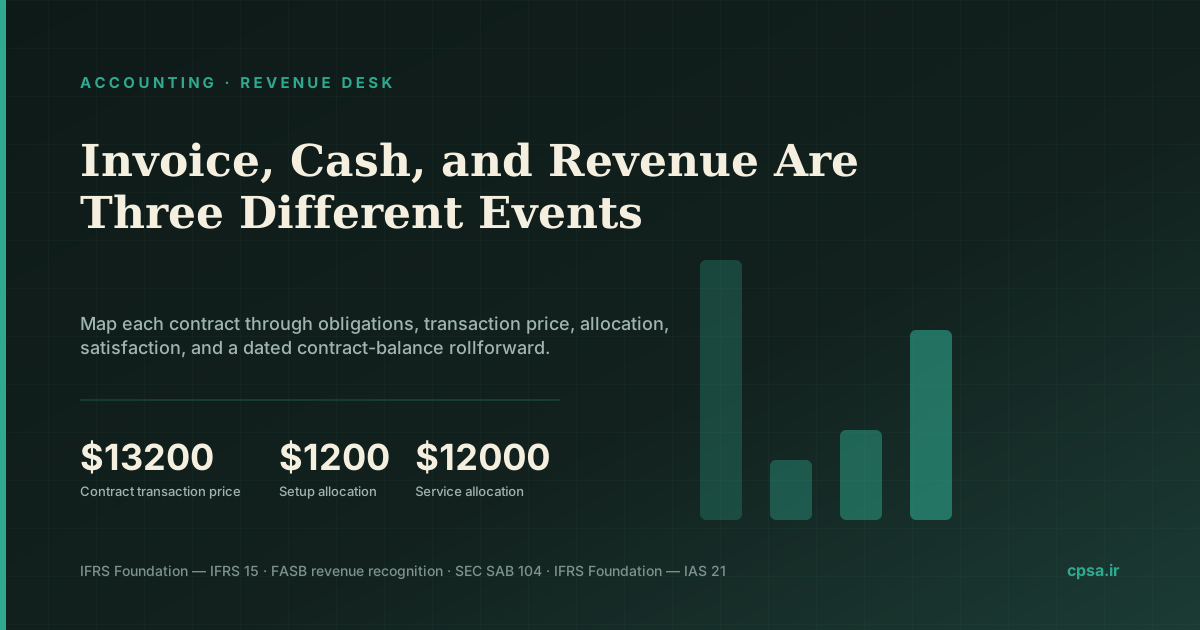
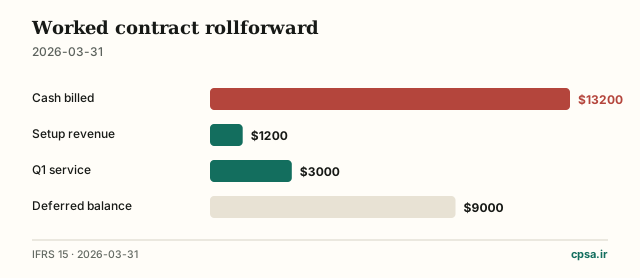
Worked contract dated 1 January 2026 in nominal USD: customer pays USD 13,200 upfront for a distinct setup and twelve months of service. Observable standalone prices are USD 2,000 and USD 20,000. Relative allocation gives setup 13,200 × 2,000 / 22,000 = USD 1,200 and service USD 12,000.
Assume setup transfers on 1 January, service transfers evenly, no refund, tax, variable consideration, significant financing component, or credit loss exists. Q1 revenue is USD 1,200 + three months × USD 1,000 = USD 4,200; deferred contract liability at 31 March is USD 9,000.
- Cash billed13,200 $
- Setup revenue1,200 $
- Q1 service3,000 $
- Deferred balance9,000 $
IFRS 15 (2026-03-31). Worked nominal-USD contract, not company data.
Control estimates and modifications
Artifact: maintain a contract memo with parties, jurisdiction, term, obligations, standalone-price evidence, variable-consideration constraint, acceptance evidence, billing schedule, journal entries, approver, and modification log. Reconcile the subledger to receivables, contract assets, contract liabilities, tax invoices, and cash.
Sensitivity: if setup is not distinct, the full USD 13,200 is recognized over twelve months at USD 1,100 monthly and Q1 revenue becomes USD 3,300, USD 900 below the base case. That classification conclusion requires contract-specific accounting judgment, not management preference.
Apply framework, currency, and tax boundaries
IFRS 15 and ASC 606 are substantially converged but presentation, disclosure, policy elections, and regulator expectations can differ. Public-company SEC guidance is not automatically the filing rule for a private entity; identify the reporting framework, entity type, and financial-statement jurisdiction.
IAS 21 governs foreign-currency accounting under IFRS. Record the transaction at the applicable dated rate and treat later monetary remeasurement separately from revenue. VAT, sales tax, withholding, e-invoicing, and taxable-income timing are jurisdiction-specific and require a licensed accountant or tax adviser; this module is not legal or tax advice.
Frequently asked questions
Does an invoice create revenue?
Not by itself. Recognition follows satisfaction of performance obligations.
Is upfront cash immediately revenue?
Usually only to the extent promised goods or services have transferred.
How are discounts allocated?
Generally by relative standalone selling prices unless the framework's criteria support a specific allocation.
Does book revenue equal taxable revenue?
Not necessarily; local tax law can use different timing and documentation.
Answers to the questions this topic usually leaves hanging.
How we sourced this
Every statistic in Invoice, Cash, and Revenue Are Three Different Events is attributed. Where a number is an estimate rather than a census, the note says so.
- IFRS Foundation — IFRS 15Authoritative revenue-recognition requirements.
- FASB revenue recognitionU.S. GAAP Topic 606 project materials.
- SEC SAB 104SEC staff revenue-recognition interpretations.
- IFRS Foundation — IAS 21Foreign-currency transaction and translation principles.
Primary sources used for this edition.
The bottom line
Select one material contract and make invoice, cash, obligation, revenue, and balance reconcile.
If you want the adjacent decisions after Invoice, Cash, and Revenue Are Three Different Events, start with Financial reporting, Finance automation, Financial controls, LTV.