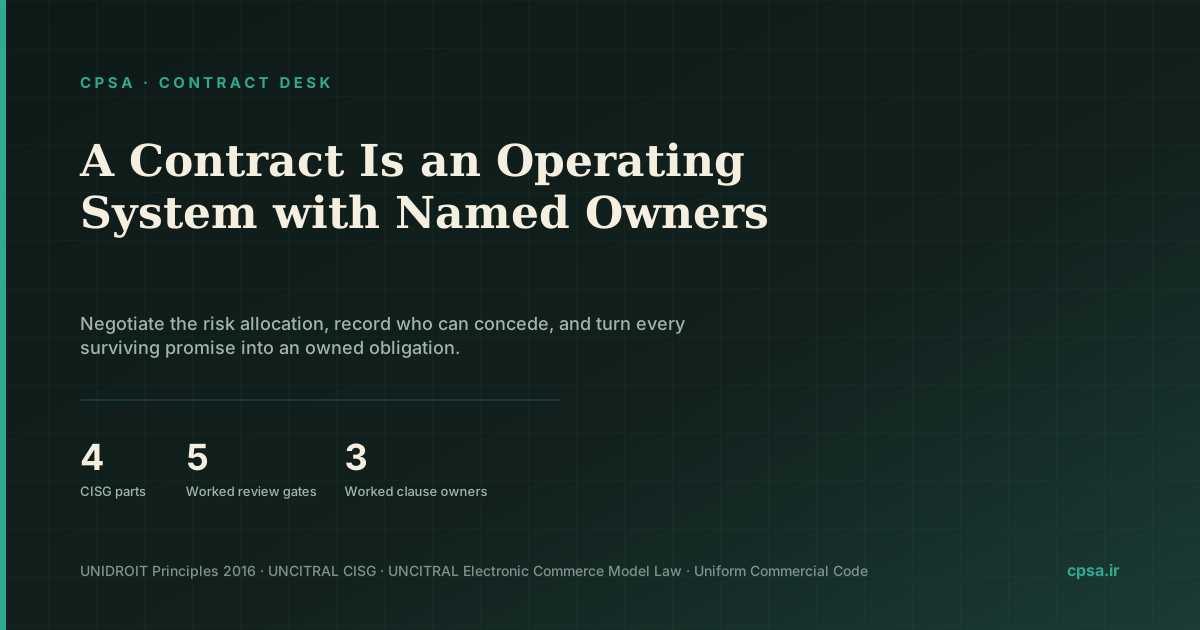
Contract work fails when negotiation and performance live in separate rooms. The sales team concedes a service level, counsel edits liability, and operations never receives the signed promise. A useful contract file therefore begins before redlines and stays open until the last obligation expires.
Build a clause map before redlines
Translate the deal into six questions: what is delivered, when payment is earned, who owns new intellectual property, what failure excuses performance, how liability is allocated, and how the relationship ends. UNIDROIT treats freedom of contract, good faith, performance, non-performance, and remedies as connected questions; the term sheet should do the same.
Give each clause a business owner and a fallback position. Counsel can explain the legal consequence of an indemnity, but only the product lead can say whether a promised response time is deliverable. Record the preferred text, the acceptable fallback, and the person authorized to cross the boundary.
Control the negotiation record and authority
Use one redline owner, one comparison baseline, and a decision log. Email chains are evidence of discussion, not a reliable final instrument. Before signature, compare the execution copy against the approved baseline and preserve attachments, schedules, order forms, and incorporated policies with the same version date.
Signature validity and corporate authority are separate checks. Electronic form may satisfy writing requirements where the governing law recognizes it, but that does not prove the signer can bind the company. Verify board delegations, signing limits, entity names, and counterpart capacity before releasing the final PDF.
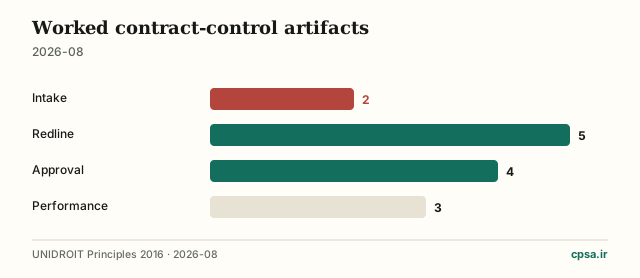
- Intake2 count
- Redline5 count
- Approval4 count
- Performance3 count
UNIDROIT Principles 2016 (2026-08). Worked example: number of named control artifacts at each contract stage; not survey data.
Turn signed language into operations
Extract obligations rather than filing the contract as a dead PDF. For each notice, renewal, milestone, audit right, price adjustment, data return, and insurance certificate, record the trigger, due date, evidence, owner, and escalation path. The register should point back to the exact clause and signed version.
Treat amendments and waivers as changes to that register. A commercial concession in a chat message may create ambiguity even when the contract demands a formal amendment. Route scope changes through price, schedule, acceptance criteria, and downstream vendor commitments before anyone promises the customer a new date.
Worked cross-border sale: choose the legal machine
Worked example: a UAE startup sells configured hardware to a German buyer. The team must ask whether the CISG applies through the parties' places of business, whether the contract excludes or modifies it, which court or arbitral seat hears disputes, and whether export, tax, and product rules create separate obligations. The example illustrates issue-spotting; it predicts no outcome.
This module was reviewed on 21 August 2026 against the cited international materials. It is not legal advice, does not state that any model law has been enacted in a particular country, and cannot select governing law for Iran, the UAE, the United States, or any other jurisdiction. Qualified counsel must test the actual parties, goods, authority, mandatory rules, and dispute clause.
Frequently asked questions
Who should own a startup contract?
A business owner should own performance; legal should own legal review and the approved form. Neither role replaces the other.
Is an electronic signature always enough?
No. Applicable law, consent, document type, authentication, and the signer's authority all matter.
Should every risk go to the counterparty?
No. Allocate a risk to the party able to control, insure, price, or verify it; otherwise the clause may only raise price or fail in performance.
Does a governing-law clause settle every issue?
No. Forum, mandatory local rules, conflict-of-laws analysis, and enforcement remain separate.
Answers to the questions this topic usually leaves hanging.
How we sourced this
Every statistic in A Contract Is an Operating System with Named Owners is attributed. Where a number is an estimate rather than a census, the note says so.
- UNIDROIT Principles 2016International commercial-contract principles on formation, performance, non-performance, and remedies.
- UNCITRAL CISGOfficial convention text and status materials for international sales.
- UNCITRAL Electronic Commerce Model LawOfficial model-law treatment of electronic records and signatures.
- Uniform Commercial CodeOfficial Uniform Law Commission materials; state enactment must be checked separately.
Primary sources used for this edition.
The bottom line
The negotiated clause matters only when its owner can perform, prove, and close it.
If you want the adjacent decisions after A Contract Is an Operating System with Named Owners, start with International legal map, Compliance auditing, Startup insurance, Employment compliance.