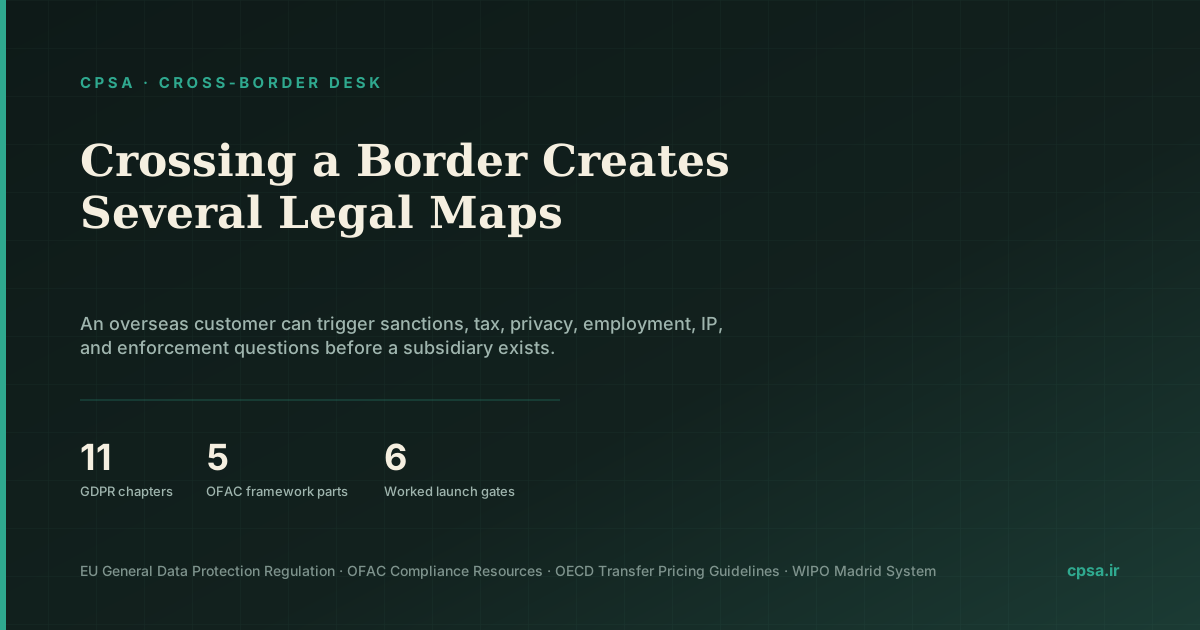
International expansion is not synonymous with incorporation abroad. A website sale, a remote hire, cloud access, a distributor, and a trademark filing each connect the company to a different rule set. Start with the facts of the activity, then identify the authorities that attach to those facts.
Map the activity before choosing an entity
Write where the customer, worker, server, inventory, payment account, decision-maker, and contracting entity sit. Those facts can create licensing, consumer, employment, tax, investment-screening, or court exposure independently. An incorporation certificate does not move the people or the transaction.
Then separate permission to form an entity from permission to conduct the activity. Foreign-ownership limits, sector licences, beneficial-owner filings, banking access, and local-director rules may follow different tests. UNCTAD's country materials are a starting index; local legislation and counsel decide the live rule.
Screen the transaction, not just the customer name
Sanctions analysis can reach the parties, beneficial owners, banks, location, currency path, goods, software, services, and end use. A name-screening hit is not automatically a prohibition, and a clean name is not automatically permission. Preserve the query, list version, ownership analysis, disposition, and approver.
OFAC's framework describes management commitment, risk assessment, internal controls, testing, and training; it does not turn a generic checklist into a licence. Export controls and sanctions are also distinct regimes. A startup with Iranian founders, a UAE entity, and US-origin software needs advice grounded in the actual persons, technology, destinations, and current lists.
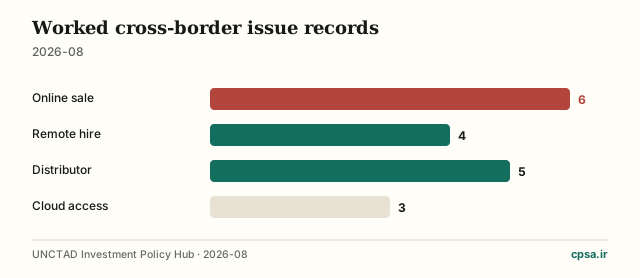
- Online sale6 count
- Remote hire4 count
- Distributor5 count
- Cloud access3 count
UNCTAD Investment Policy Hub (2026-08). Worked example: issue records opened for four expansion activities; counts are not prevalence data.
Treat data movement as a governed operation
Identify whose personal data enters the product, the purpose, the controller and processor roles, storage and support locations, recipients, retention, security, and deletion path. Under the GDPR, territorial scope and transfer rules require separate analysis; a privacy policy does not itself establish a lawful basis or transfer mechanism.
Create a data-transfer record before giving a new support team or vendor access. It should name the data categories, systems, countries, legal mechanism, safeguards, incident route, and termination deletion. Reassess when the vendor changes subprocessors or when a new feature changes purpose.
Coordinate tax, people, IP, and enforcement
Worked example: a Canadian company appoints a salesperson in Dubai, licenses software to a German customer, and pays an Iranian contractor. The issue list may include permanent-establishment and payroll analysis, local employment status, VAT, sanctions, data transfer, contractor IP assignment, trademark coverage, governing law, and enforceability. These are questions for separate qualified advisers, not conclusions from the scenario.
Information here is limited to issue-spotting as reviewed on 21 August 2026. Treaty positions, sanctions lists, tax rules, privacy decisions, and national enactments change, sometimes without aligning across authorities. This is not legal or tax advice; obtain current advice in every jurisdiction connected to the planned activity before launch.
Frequently asked questions
Do we need a subsidiary before selling abroad?
Not always. But selling without one can still create tax, licensing, consumer, privacy, sanctions, and enforcement obligations.
Is checking a sanctions list enough?
No. Ownership, control, location, banks, goods, technology, services, and end use may matter.
Does hosting data in Europe make us GDPR-compliant?
No. Scope, roles, lawful basis, transparency, security, rights, retention, and transfers remain.
Does a trademark registration protect every country?
No. Rights are territorial. The Madrid System can streamline applications, but designated offices still apply their law.
Answers to the questions this topic usually leaves hanging.
How we sourced this
Every statistic in Crossing a Border Creates Several Legal Maps is attributed. Where a number is an estimate rather than a census, the note says so.
- EU General Data Protection RegulationOfficial EUR-Lex text for scope, roles, rights, security, and transfers.
- OFAC Compliance ResourcesOfficial sanctions-compliance framework and current compliance resources.
- OECD Transfer Pricing GuidelinesOfficial guidance for cross-border transactions between associated enterprises.
- WIPO Madrid SystemOfficial international trademark filing system and territorial limits.
- UNCTAD Investment Policy HubOfficial country and treaty index for investment-policy research.
Primary sources used for this edition.
The bottom line
A country launch is ready when every real-world connection has an owner, authority, and dated answer.
If you want the adjacent decisions after Crossing a Border Creates Several Legal Maps, start with Contract management, Industry regulation, Compliance audit, Employment law.