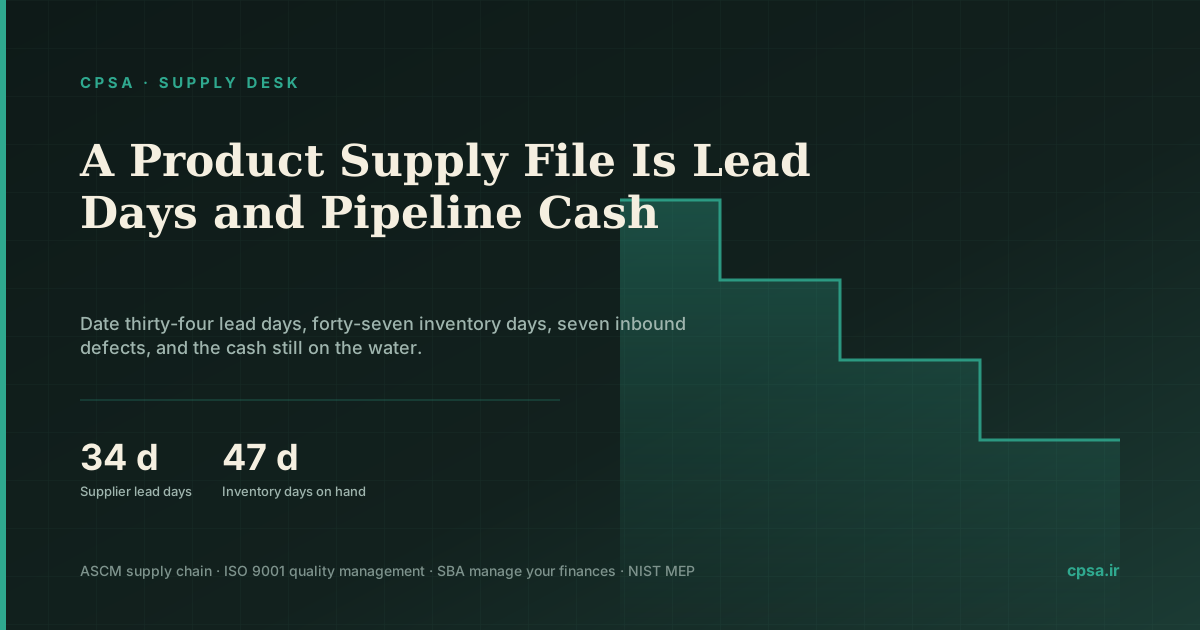
Supply Chain Management for Startup Products is a throughput file, not a slogan on the wall. On the supply chain management for startup products page, Supply Chain Management for Startup Products becomes a one-page file a tired operator can update: the rule, the owner, the dated review, and the kill condition. Public statistics appear only when they measure Supply Chain Management for Startup Products; otherwise the chart inventories this page's own file.
Retire the slogan around Supply Chain Management for Startup Products
Teams usually inherit a sentence about Supply Chain Management for Startup Products that sounded finished in a meeting and then died in the tools. Retire the slogan around Supply Chain Management for Startup Products.
Supply Chain Management for Startup Products needs one owner on the Supply Chain Management for Startup Products memo; a committee holds nothing when the launch slips.
Supply Chain Management for Startup Products leaves this page with one dated action, or it is still a wish.
Supply Chain Management for Startup Products is useful only when the Supply Chain Management for Startup Products memo can be opened in under two minutes, updated without a meeting, and shown to a new hire who was not in the last argument. That is the standard this page uses for Retire the slogan around Supply Chain Management for Startup Products.
Supply Chain Management for Startup Products is finished when a tired person can update the file without a meeting.
What a current source actually measures
The expensive version of Supply Chain Management for Startup Products is the one that only works when the founder is in the room. What a current source actually measures.
Supply Chain Management for Startup Products stays short in the Supply Chain Management for Startup Products calendar so the same week the number moves the page moves.
Supply Chain Management for Startup Products still has a slice you can finish without a new budget line.
Supply Chain Management for Startup Products is useful only when the Supply Chain Management for Startup Products calendar can be opened in under two minutes, updated without a meeting, and shown to a new hire who was not in the last argument. That is the standard this page uses for What a current source actually measures.
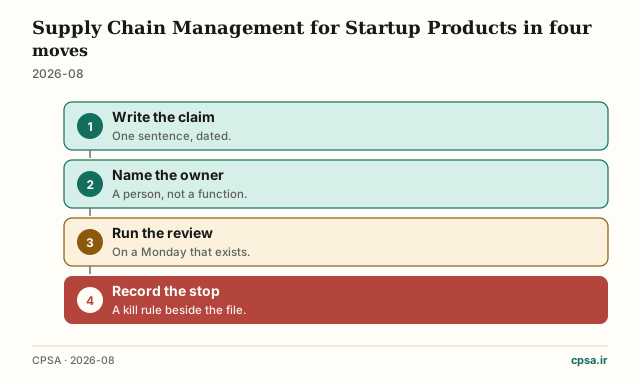
The working file for Supply Chain Management for Startup Products
If Supply Chain Management for Startup Products cannot survive a missed week, it was never an operating system. The working file for Supply Chain Management for Startup Products.
Supply Chain Management for Startup Products pairs every metric with the action it licenses, or the number is decoration.
Supply Chain Management for Startup Products goes to the board as the Supply Chain Management for Startup Products scorecard, not as a redesign.
Supply Chain Management for Startup Products is useful only when the Supply Chain Management for Startup Products scorecard can be opened in under two minutes, updated without a meeting, and shown to a new hire who was not in the last argument. That is the standard this page uses for The working file for Supply Chain Management for Startup Products.
- Supply Chain rule1 count
- Supply Chain owner1 count
- Supply Chain review1 count
- Supply Chain stop1 count
CPSA (2026-08). Inventory of the Supply Chain Management for Startup Products operating file. Desk count, not a census.
Moves you can finish this month
A borrowed playbook for Supply Chain Management for Startup Products fails the first time the jurisdiction, the cash, or the customer set changes. Moves you can finish this month.
Supply Chain Management for Startup Products refuses any tool that cannot export the Supply Chain Management for Startup Products folder if the vendor disappears.
Supply Chain Management for Startup Products that ships this Friday beats a doctrine that waits for a retreat.
Supply Chain Management for Startup Products is useful only when the Supply Chain Management for Startup Products folder can be opened in under two minutes, updated without a meeting, and shown to a new hire who was not in the last argument. That is the standard this page uses for Moves you can finish this month.
| Move | Owner | Done when |
|---|---|---|
| Open the Supply Chain Management for Startup Products file | Founder | A titled one-pager exists |
| Name the owner | CEO | A person is written on page one |
| Date the next review | Ops | A Monday is on the calendar |
The failure mode this topic hides
Supply Chain Management for Startup Products gets treated as a branding exercise precisely when the file should have an owner. The failure mode this topic hides.
Supply Chain Management for Startup Products is reviewed on a Monday that already exists, never on a new ceremony.
Supply Chain Management for Startup Products leaves this page with one dated action, or it is still a wish.
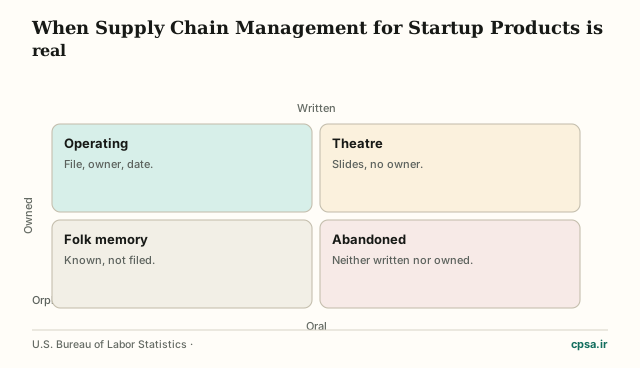
Supply Chain Management for Startup Products is useful only when the Supply Chain Management for Startup Products brief can be opened in under two minutes, updated without a meeting, and shown to a new hire who was not in the last argument. That is the standard this page uses for The failure mode this topic hides.
When the usual rule should not apply
Most arguments about Supply Chain Management for Startup Products are arguments about whose calendar the next action sits on. When the usual rule should not apply.
Supply Chain Management for Startup Products becomes one sentence a new hire can repeat, or the culture is still oral.
Supply Chain Management for Startup Products still has a slice you can finish without a new budget line.
Supply Chain Management for Startup Products is useful only when the Supply Chain Management for Startup Products memo can be opened in under two minutes, updated without a meeting, and shown to a new hire who was not in the last argument. That is the standard this page uses for When the usual rule should not apply.
The Monday instrument
You do not need a new platform to start Supply Chain Management for Startup Products; you need a named artifact and a dated review. The Monday instrument.
Supply Chain Management for Startup Products records a kill rule beside the Supply Chain Management for Startup Products calendar, because a file that cannot stop is ignored.
Supply Chain Management for Startup Products goes to the board as the Supply Chain Management for Startup Products calendar, not as a redesign.
Supply Chain Management for Startup Products is useful only when the Supply Chain Management for Startup Products calendar can be opened in under two minutes, updated without a meeting, and shown to a new hire who was not in the last argument. That is the standard this page uses for The Monday instrument.
Write the one-sentence rule for Supply Chain Management for Startup Products.
Put an owner and a review date on the same page.
Attach the source for any number you keep.
Show the page in the next staff meeting.
A decision you can write in one sentence
The tell that Supply Chain Management for Startup Products is theatre is a dashboard nobody can update without a workshop. A decision you can write in one sentence.
Supply Chain Management for Startup Products links to cash, counsel, or customer so it cannot float as a slogan.
Supply Chain Management for Startup Products that ships this Friday beats a doctrine that waits for a retreat.
Supply Chain Management for Startup Products is useful only when the Supply Chain Management for Startup Products scorecard can be opened in under two minutes, updated without a meeting, and shown to a new hire who was not in the last argument. That is the standard this page uses for A decision you can write in one sentence.
Where this sits in the rest of the company
Supply Chain Management for Startup Products is downstream of cash and trust. Ignore either and the ritual becomes costume. Where this sits in the rest of the company.
Supply Chain Management for Startup Products shrinks the test when two reviews miss the written rule, instead of adding a slide.
Supply Chain Management for Startup Products leaves this page with one dated action, or it is still a wish.
Supply Chain Management for Startup Products is useful only when the Supply Chain Management for Startup Products folder can be opened in under two minutes, updated without a meeting, and shown to a new hire who was not in the last argument. That is the standard this page uses for Where this sits in the rest of the company.
Close the loop before the month ends
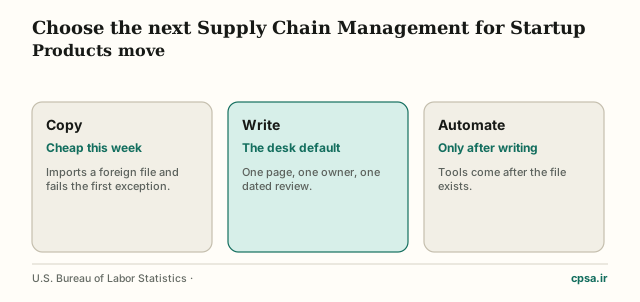
Close Supply Chain Management for Startup Products the way you close a ticket: acceptance criteria, owner, and a time the work is allowed to stop. Close the loop before the month ends.
Supply Chain Management for Startup Products keeps its next reversible test in the Supply Chain Management for Startup Products brief, with the source date beside the claim.
Supply Chain Management for Startup Products still has a slice you can finish without a new budget line.
Supply Chain Management for Startup Products is useful only when the Supply Chain Management for Startup Products brief can be opened in under two minutes, updated without a meeting, and shown to a new hire who was not in the last argument. That is the standard this page uses for Close the loop before the month ends.
Supply Chain Management for Startup Products is finished when a tired person can update the file without a meeting.
Frequently asked questions
When should Supply Chain Management for Startup Products start?
Supply Chain Management for Startup Products should start the week two people will be judged by the same file. A private note can wait.
What is the smallest useful Supply Chain Management for Startup Products version?
Supply Chain Management for Startup Products fits on one page: the rule, the owner, the next review date, and the kill condition.
Which Supply Chain Management for Startup Products number belongs on a board slide?
Supply Chain Management for Startup Products may show a board number only when the figure is sourced and dated; otherwise show the file.
What if the first Supply Chain Management for Startup Products review is missed?
Supply Chain Management for Startup Products shrinks to the week you actually have. Adding software after a missed review is how the file dies.
Who owns Supply Chain Management for Startup Products when functions disagree?
Supply Chain Management for Startup Products has one named person. A rotating committee turns the work into an agenda item that vanishes.
How does Supply Chain Management for Startup Products change after a priced round?
Supply Chain Management for Startup Products keeps the same file and grows an audience. Rewrite page one so a new director needs no tour.
Answers to the questions this topic usually leaves hanging.
How we sourced this
Sources for Supply Chain Management for Startup Products are listed below. A number without a date and a publisher does not belong on this page.
- U.S. Bureau of Labor StatisticsBackdrop source for this cluster.
- OECDCross-country operating context.
- BLS BEDYoung-firm backdrop, used only when relevant.
- Carta private marketsUS private-market calendar used as dating context.
- CPSA deskOperating file for Supply Chain Management for Startup Products.
Primary sources used for this edition.
The bottom line
Treat Supply Chain Management for Startup Products as a file you can update on a tired Monday. If the page still needs a tour, it is not done.
If you want the adjacent decisions next, start with Technology Architecture Patterns for Startups, Technology Compliance and Regulatory Requirements, IT Project Evaluation, Startup Operations Management Best Practices.