Lawful tax optimization means choosing supported timing, structure, elections, and incentives after identifying where the company, workers, customers, assets, and transactions create obligations. It does not mean applying one country's rate to a global startup model.
Map entities, people, customers, and flows
For every legal entity and branch, list incorporation, management location, offices, workers, contractors, inventory, intellectual property, bank accounts, payment processors, customer locations, and intercompany transactions. Ask local advisers which facts create income, payroll, VAT or sales-tax, withholding, permanent-establishment, and filing duties.
Create a tax calendar by obligation rather than one annual deadline: registration, invoice issuance, payroll deposit, withholding, indirect tax, estimated income tax, information returns, transfer-pricing documentation, statutory accounts, and renewal. Record authority, form, period, currency, owner, preparer, reviewer, payment rail, and evidence.
Build a transparent book-to-tax bridge
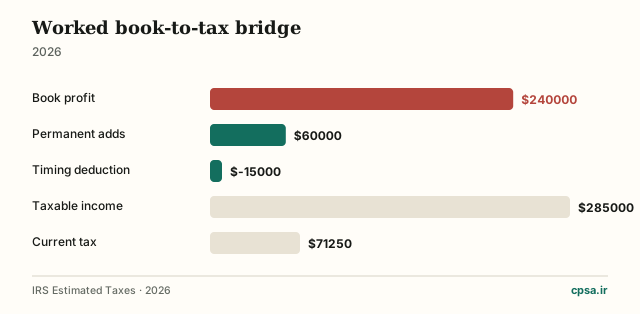
Worked 2026 example in nominal USD: book profit before tax is USD 240,000; add USD 60,000 of assumed permanently nondeductible items and deduct USD 15,000 of assumed timing differences. Illustrative taxable income is 240,000 + 60,000 - 15,000 = USD 285,000.
Applying an explicitly assumed 25% rate gives USD 71,250 current tax and a mechanically even quarterly reserve of USD 17,812.50. The rate, deductibility, installments, losses, credits, deferred tax, and due dates are not legal conclusions; replace every assumption with enacted rules and adviser sign-off for the entity and period.
- Book profit240,000 $
- Permanent adds60,000 $
- Timing deduction-15,000 $
- Taxable income285,000 $
- Current tax71,250 $
IRS Estimated Taxes (2026). Worked book-to-tax components; 25% is an explicit assumption, not a jurisdictional rate.
Optimize supported choices, not labels
Evaluate elections, compensation mix, research incentives, loss use, entity funding, capital-versus-expense treatment, indirect-tax recovery, and transaction timing only after commercial purpose, eligibility, documentation, cash cost, accounting effect, and anti-avoidance rules are reviewed. Preserve contemporaneous evidence rather than reconstructing intent at audit.
OECD BEPS and transfer-pricing materials address cross-border base erosion and arm's-length outcomes, but domestic adoption and documentation thresholds differ. A contract between affiliates does not prove conduct or price; align functions, assets, risks, invoices, cash, and actual decision-making.
Fund sensitivity and jurisdiction review
Sensitivity: at an assumed 20% rate, tax on USD 285,000 is USD 57,000; at 30% it is USD 85,500, a USD 28,500 range. Keep the reserve in payment currency, state the dated exchange rate for consolidation, and separately stress devaluation, late-payment interest, disputed deductions, and collection timing.
Artifact: maintain a jurisdiction matrix with nexus fact, tax type, registration, filing and payment dates, rate source, currency, return status, adviser, uncertain position, exposure, and evidence link. IRS sources here cover U.S. federal context only; they do not determine Iranian, state, local, or other-country obligations. This is educational content, not tax or legal advice.
Frequently asked questions
When should a startup hire a tax adviser?
Before entering a new jurisdiction, hiring across borders, issuing equity, restructuring, or making material intercompany transactions.
Does a loss mean no tax filing?
No. Filing, payroll, withholding, indirect tax, minimum tax, and information duties may still apply.
Can book expense always be deducted?
No. Deductibility, timing, evidence, related-party, and capitalization rules are jurisdiction-specific.
Is the 25% example a tax rate?
No. It is a labeled calculation assumption solely for demonstrating the bridge.
Answers to the questions this topic usually leaves hanging.
How we sourced this
Every statistic in Tax Planning Starts With Nexus, Evidence, and Due Dates is attributed. Where a number is an estimate rather than a census, the note says so.
- IRS estimated taxesU.S. federal estimated-tax context and payment cadence.
- IRS recordkeepingU.S. federal business record principles.
- OECD base erosion and profit shiftingCross-border anti-avoidance policy context.
- OECD transfer pricing guidelinesArm's-length analysis for multinational related parties.
Primary sources used for this edition.
The bottom line
List every entity and operating location, then assign a qualified local reviewer to each obligation.
If you want the adjacent decisions after Tax Planning Starts With Nexus, Evidence, and Due Dates, start with Financial reporting, Financial risk, International legal, Finance automation.