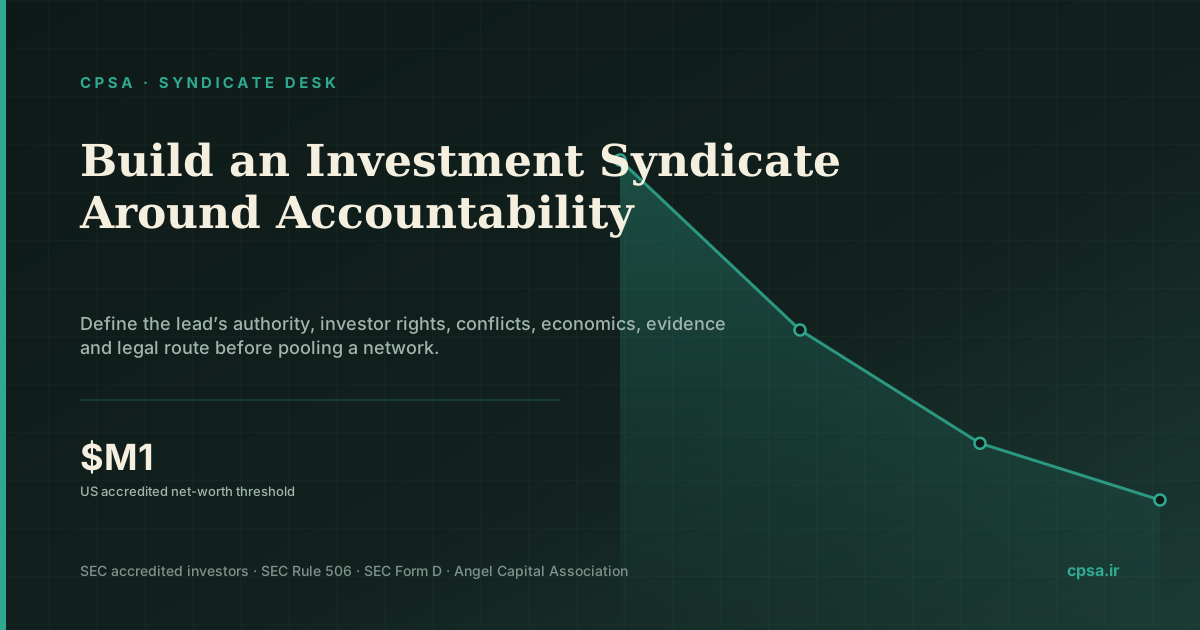
A syndicate is not a group chat that likes the same deal. It is an allocation of authority, economics, information, liability and post-close work among a lead, participating investors, the issuer and often a special-purpose vehicle or platform.
Define the lead’s accountable job
Write who sources, screens, verifies conflicts, directs diligence, negotiates allocation, coordinates counsel, handles funds, signs, reports, votes and manages follow-ons. State which powers are advisory and which are legally delegated. Reputation does not substitute for authority, competence or documented conflict handling.
The labeled workload assigns different hours to diligence, legal work, closing and reporting only to expose ownership. It is not a staffing benchmark. If no one accepts the recurring six-hour reporting job in the example, the syndicate is not operationally ready regardless of investor demand.
- Diligence18 h
- Legal and compliance12 h
- Allocation and closing8 h
- Portfolio reporting6 h
Angel Capital Association (labeled example). Illustrative owner-hours by workstream; not a fee or staffing benchmark.
Show economics and rights before interest
Disclose the security, issuer cap table effect, SPV or direct ownership, fees, carry, expenses, allocation policy, minimum and maximum, cancellation treatment, voting, information rights, transfers, conflicts, tax reporting, follow-on rights and wind-up. Model gross and net outcomes across downside and upside.
Seventeen investors in the worked syndicate are a labeled example, not an optimal size. More participants increase communications, identity checks, signatures, tax records and consent complexity. A single vehicle may simplify the issuer’s cap table while adding its own governance, cost and regulatory obligations.
Keep diligence independent and reusable
The lead should publish the investment thesis, evidence index, material contrary facts, scope limits, conflicts and open items. Participants need enough time and access to make their own decision. A lead’s commitment signals alignment but does not prove valuation, legality, security or suitability.
After close, preserve a decision record and a reporting contract: source definitions, period, cash position, material events, rights, votes and next financing. Network value compounds when members can trust consistent evidence and bounded requests, not when every portfolio company can broadcast to everyone.
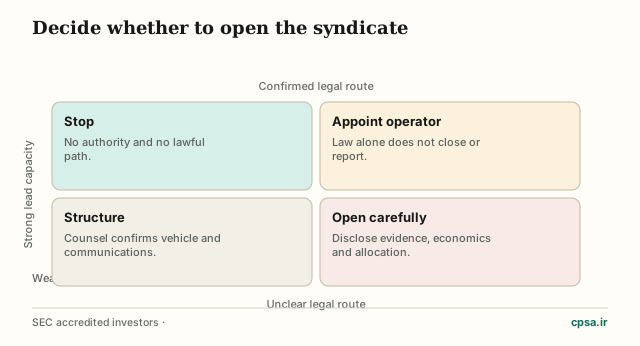
Choose the legal route before solicitation
In the US, Rule 506(b) generally prohibits general solicitation and permits limited non-accredited participation subject to conditions; Rule 506(c) permits broad solicitation but requires all purchasers to be accredited and the issuer to take reasonable verification steps. Form D is generally due within 15 days after the first sale, and state notice obligations may remain.
These are US federal reference points, not instructions for Iran, UAE, UK, EU, Canada or cross-border syndicates. Securities, fund, broker, platform, custody, AML/KYC, sanctions, privacy, tax, foreign ownership and exchange-control rules vary. Qualified counsel must structure the issuer and vehicle before money or public communications.
Frequently asked questions
Does a syndicate need an SPV?
Not always. Compare direct ownership with vehicle governance, cost, tax, regulation and issuer cap-table needs.
Can the lead guarantee diligence?
No. The lead should disclose scope and evidence; each participant makes an independent decision.
Is accreditation enough to participate?
No. Eligibility, suitability, sanctions, vehicle documents and the chosen exemption still matter.
When is Form D due?
For covered US Regulation D offerings, generally within 15 days after the first sale; counsel should confirm federal and state filings.
Answers to the questions this topic usually leaves hanging.
How we sourced this
Every statistic in Build an Investment Syndicate Around Accountability is attributed. Where a number is an estimate rather than a census, the note says so.
- SEC accredited investorsOfficial US qualification categories and thresholds.
- SEC Rule 506Official differences between 506(b) and 506(c).
- SEC Form DOfficial federal notice timing.
- Angel Capital AssociationAngel-group process and education context.
Primary sources used for this edition.
The bottom line
A durable investor network is built by accountable work and clean disclosures, not pooled enthusiasm.
If you want the adjacent decisions after Build an Investment Syndicate Around Accountability, start with Angel relationships, Types of investors, Deal flow, Term-sheet tactics.