Each capital source is a different contract about time, control, follow-on, and what success means. This page matches the check to the job you actually have.
The matching question
Ask what remaining uncertainty this check must retire. An angel can underwrite a founder and a first customer. A seed fund underwrites a small portfolio of the same. A venture firm underwrites a power-law outcome. A corporate underwrites a strategic option. A family office underwrites patience.
Then ask what the investor cannot do. An angel without reserves cannot finance a factory, and a growth fund whose mandate excludes pre-revenue companies cannot rescue an experiment. A prestigious introduction does not repair a mandate mismatch.
A side-by-side of the common types
Angels write personal checks and rarely reserve. Seed funds write first institutional checks. Venture firms expect to lead later rounds. Corporates add a customer or channel and often a veto. Family offices add time and subtract process.
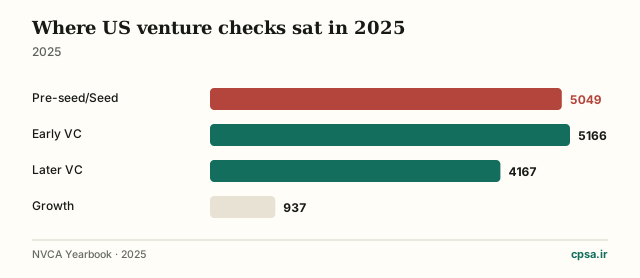
NVCA’s 2025 US table: 5,049 pre-seed/seed deals against 937 growth deals. Most first checks never become last checks.
- Pre-seed/Seed5,049 count
- Early VC5,166 count
- Later VC4,167 count
- Growth937 count
NVCA Yearbook (2025). US deal counts as a proxy for where institutional capital sits.
Worked match: two founders, two wrong rooms
A Mashhad B2B tools company with three paying clinics and no US Series A plan needs an angel or family office who understands local collections, not a Sand Hill firm. A climate hardware company that needs $25 million of plant needs a fund with reserves, not a dentist-angel syndicate.
A second pair shows the opposite error: a profitable exporter seeking patient working capital may be distorted by a VC return clock, while a software company planning repeated institutional rounds may be stranded by a family office that never reserves. The right room follows the next financing job, not the founder’s preferred label.
When to refuse the check
Refuse a corporate check if the corporate is also your only path to market and the side letter lets them block other channels. Refuse a seed fund that cannot explain its reserve policy. Refuse an angel who wants a board seat for a $50,000 check.
Control, information rights, and follow-on expectations belong in the price of the check. A smaller clean check can be cheaper than a larger check that blocks customers or forces a financing timetable the company cannot meet.
Iran and thin follow-on markets
In a market where priced follow-ons are rare, the best investor is the one who does not require a later US-style round to stay friendly. Ask: what happens if no one else shows up?
Write the answer as a cash plan: whether the investor can bridge, whether the company can reach break-even, and which costs stop first. Verbal enthusiasm about future introductions is not a reserve and should not appear in the runway.
Frequently asked questions
Should my first institutional check be corporate?
Only if the corporate is a real customer and cannot block other customers.
How many angels are too many?
If you cannot list them on one page with amounts and emails, you already have too many.
Do family offices replace venture firms?
They replace impatience, not process-plant capital.
What does the NVCA funnel mean?
Plan as if the first check is the last unless a reserve is written.
Answers to the questions this topic usually leaves hanging.
How we sourced this
Every statistic in Pick the Investor Who Can Finish the Job is attributed. Where a number is an estimate rather than a census, the note says so.
- NVCA 2026 YearbookUS deal counts by stage.
- Carta State of Private Markets Q3 2025Stage mix and seed share of events.
- Angel Capital AssociationDefinitions of angel versus institutional seed.
- OECD venture notesCross-country context for CVC motives.
Primary sources used for this edition.
The bottom line
Pick the investor who can live with your actual next twelve months.
If you want the adjacent decisions after Pick the Investor Who Can Finish the Job, start with Funding rounds as a calendar, SAFE agreements, Angel relationships, Why startups fail.