A Simple Agreement for Future Equity is a conversion contract, not a compliment. Y Combinator’s current standard is the post-money SAFE: the investor’s ownership is calculated against the post-money cap when a priced equity round happens. Until that round, you have sold a slice of a company whose price is still unstated. This page walks the conversion, the dilution of everyone else, and the jurisdictions where the form should not be pasted.
What the post-money form actually says
On an equity financing, the SAFE converts into preferred shares at the lower of the cap price and the discounted round price. Ownership is measured against the post-money capitalization, so later SAFEs dilute earlier SAFE holders less than the old pre-money form did — and they dilute founders more transparently. Read the YC user guide, not a blog paraphrase, before you sign.
The cap is not the company’s present valuation, and the discount is not guaranteed ownership today. They are alternative conversion mechanics triggered by the later financing; the document’s definitions decide which capitalization and securities enter the denominator.
Worked dilution on a $2 million cap
A $200,000 SAFE on a $2 million post-money cap is buying about 10% if the next round prices above the cap. If you then sell another $200,000 SAFE on the same cap, the second investor also buys about 10%, and you — not the first SAFE — absorb most of that second slice. Write both conversions on one cap table before the second signature.
Contrast a $100,000 SAFE on that same $2 million cap: its simple cap fraction is about 5%, before the priced round’s new money and any option-pool change. The two examples show why check size and cap must be modeled together; quoting the cap alone conceals the slice.
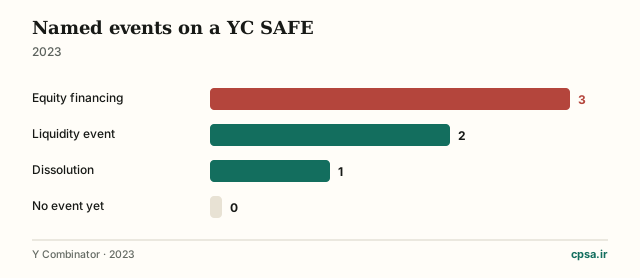
- Equity financing3 count
- Liquidity event2 count
- Dissolution1 count
- No event yet0 count
Y Combinator (2023). Illustrative event weights for named outcomes in the YC post-money SAFE user guide — not observed frequencies.
SAFE is not a loan and not a priced share
There is no interest and no maturity in the standard YC form. There is also no current share certificate. If you need repayment, use a note. If you need a current price, run a priced round. A SAFE that everyone describes as “debt” is a misunderstanding you will pay for at the first cleanup.
A side promise to repay on a date changes the commercial bargain even if the PDF still says SAFE. Do not solve that contradiction with email; choose an instrument whose written rights match what both parties expect.
Jurisdiction: do not paste the PDF
The YC SAFE assumes Delaware (or similar US) corporate law, US securities exemptions, and a later priced preferred round. Iranian commercial companies, UAE mainland or free-zone vehicles, and many EU private companies do not have that machinery. Counsel must map conversion into the local share class — or tell you to use a local instrument. This page is not legal advice.
The governing-law clause does not by itself create a share class, registration exemption, or corporate approval that local law lacks. Counsel should identify the approval, issuance, and enforcement path before money moves, not after a conversion dispute.
When a SAFE is the wrong paper
If no priced round is plausible, a SAFE is a delayed fight about price. If the investor wants repayment, it is the wrong instrument. If you already have messy common stock and option promises, clean the cap table first. NVCA 2026 Yearbook seed volume is a US fact; Carta private-markets calendars date that market. Neither makes a US form valid in Mashhad. NVCA model legal documents are the priced-round contrast, not a paste kit.
It is also poor paper when the company and investor already agree on price and can complete a priced issuance: delaying known ownership adds ambiguity without buying speed. Conversely, a short bridge to a credible priced round can fit the instrument if conversion and jurisdiction are understood.
Frequently asked questions
Does a SAFE make the investor a shareholder today?
No. Conversion happens on a named event. Until then they hold a contract.
Should I use a pre-money SAFE?
YC retired that as the default. If someone hands you a pre-money form, model both and ask why.
Can I use the YC PDF in Iran?
Not without local counsel rewriting conversion into a valid local share class. Pasting is not closing.
SAFE or convertible note?
A note has interest and maturity. Use it when the investor needs a debt story. Use a SAFE when both sides accept conversion-only.
Answers to the questions this topic usually leaves hanging.
How we sourced this
Every statistic in A SAFE Is a Price You Have Not Named Yet is attributed. Where a number is an estimate rather than a census, the note says so.
- Y Combinator SAFE documentsPost-money SAFE and user guide.
- NVCA 2026 YearbookUS seed-stage deal context.
- NVCA model legal documentsPriced-round contrast to SAFE paper.
- Carta private marketsUS seed calendar used only as dating context.
Primary sources used for this edition.
The bottom line
If you cannot draw the conversion on one cap-table page, you are not ready to sign the SAFE.
If you want the adjacent decisions after A SAFE Is a Price You Have Not Named Yet, start with Notes vs equity, Cap tables, Funding rounds, Legal structure.