A term sheet allocates outcomes in good, ordinary, and bad futures. The headline valuation matters, but liquidation preference, participation, dividends, anti-dilution, option-pool placement, board composition, protective provisions, founder vesting, exclusivity, and closing conditions decide who gets cash and who can say no. Negotiate the package through modeled scenarios.
Rank terms before you trade
Separate economics, control, and process. Economics includes price, liquidation preference, participation, dividends, anti-dilution, pay-to-play, and the option pool. Control includes board seats, voting, protective provisions, information rights, and founder restrictions. Process includes exclusivity, expenses, diligence, conditions, confidentiality, and closing date.
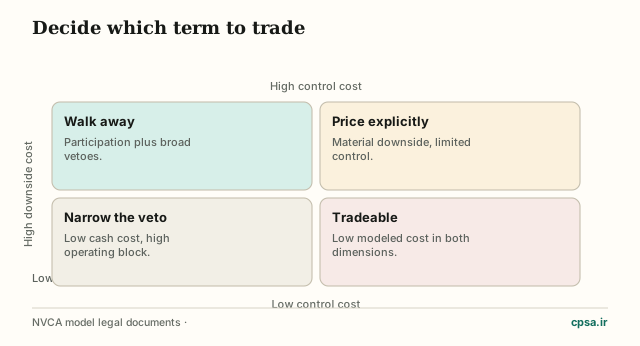
Set a target, acceptable fallback, and walk-away reason for every material term before investor calls. Trade across categories deliberately: a slightly lower valuation may be rational for clean 1x non-participating preference and a balanced board; a high headline can be expensive when paired with participation, seniority, or broad vetoes.
Model the downside before the upside
Build exit waterfalls at values below, near, and above post-money. For each security, apply seniority, preference multiple, participation, caps, conversion choice, and dividends exactly as drafted. Then show cash to each class and holder. A term you cannot put into a waterfall is not ready to accept.
Model control in the same scenarios. Ask who approves a sale, next financing, budget, debt, senior hire, option grant, charter amendment, or related-party transaction. Protective provisions should protect the investment class from fundamental harm, not move ordinary operating decisions to a minority investor.
Worked example: compare four $6 million exits
Illustrative example, not a benchmark: an investor puts in $2 million for 20%. At a $6 million exit, common-only economics return $1.2 million to the investor and $4.8 million to others. With 1x non-participating preference, the investor takes $2 million instead of converting, leaving $4 million.
With uncapped 1x participation, the investor first receives $2 million and then 20% of the remaining $4 million, totaling $2.8 million and leaving $3.2 million. A 2x non-participating preference returns $4 million and leaves $2 million. The comparison does not predict an exit; it exposes the term's downside allocation.
- Common only4.8 $M
- 1x non-part.4 $M
- 1x participating3.2 $M
- 2x preference2 $M
NVCA Yearbook (worked example). Illustrative founder proceeds across term structures at a $6m exit.
Protect the close and respect jurisdiction
Treat exclusivity as a dated option granted to the investor. Tie it to a diligence list, document turnaround, financing proof where appropriate, and a hard expiry. Define who pays expenses and whether reimbursement survives a failed close. Do not announce cash until definitive documents are signed and closing conditions are satisfied.
NVCA documents and Delaware law provide US reference points, while securities-law obligations still apply to exempt offerings. Iranian, UAE, UK, EU, and other entities have different share classes, approvals, foreign-investment restrictions, tax, exchange-control, and enforceability rules. Local counsel must draft the actual deal; this is not legal or investment advice.
Frequently asked questions
Which term should founders negotiate first?
Start with the package: downside economics, board and veto control, dilution, and closing certainty—not valuation alone.
Is 1x liquidation preference always harmless?
No. Participation, seniority, dividends, and exit value change the result. Model the exact draft.
How long should exclusivity last?
There is no universal benchmark. Set a dated period tied to concrete investor work and an automatic expiry.
Can I negotiate from an NVCA template outside the US?
Use it only as issue-spotting context. Local counsel must map every right into governing law.
Answers to the questions this topic usually leaves hanging.
How we sourced this
Every statistic in Negotiate the Term Sheet by Downside and Control is attributed. Where a number is an estimate rather than a census, the note says so.
- NVCA model legal documentsUS model term sheet and definitive venture documents.
- Y Combinator Series A term sheetFounder-oriented US term-sheet reference.
- SEC exempt offeringsOfficial reminder that exempt offerings remain regulated.
- Delaware General Corporation LawGoverning-law reference for Delaware corporate approvals and rights.
Primary sources used for this edition.
The bottom line
If a term has not been translated into cash, ownership, control, and closing time, do not trade it yet.
If you want the adjacent decisions after Negotiate the Term Sheet by Downside and Control, start with Pre-money valuation, Cap table planning, Investment diligence, SAFE agreements.