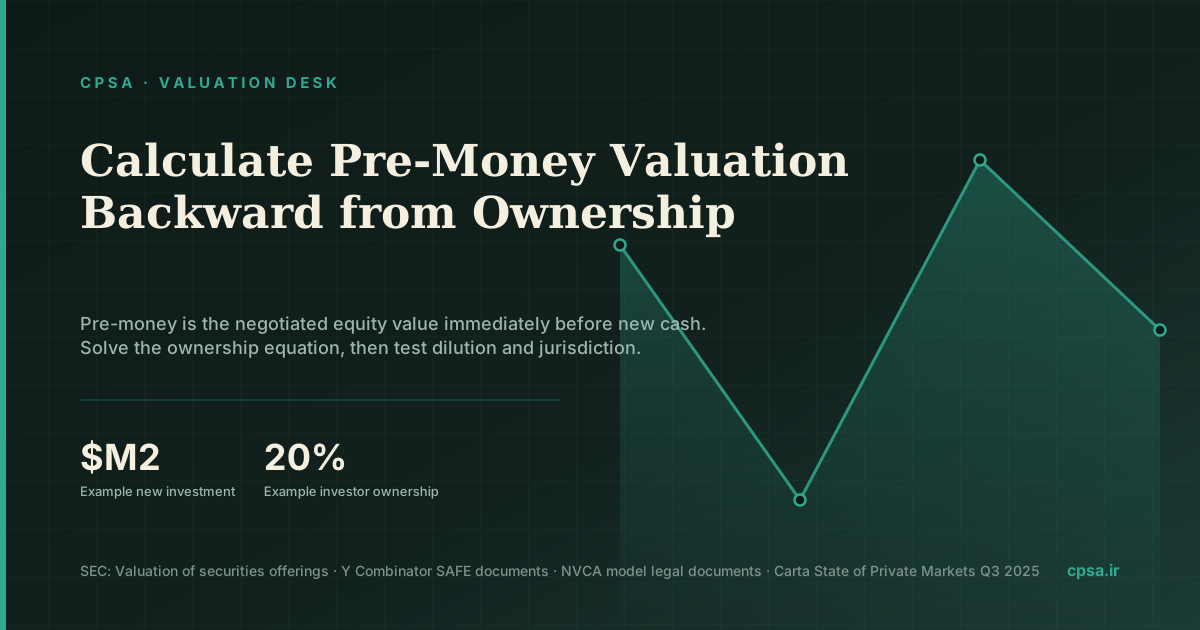
Pre-money valuation is not an appraisal certificate. In a priced financing it is the equity value negotiated immediately before the investor's new cash; post-money equals pre-money plus that cash. Start with the investor's check and negotiated post-close ownership, solve backward, and put every option-pool or converting-security assumption on the same cap table.
Solve the ownership equation first
For a simple priced round, investor ownership equals new investment divided by post-money valuation. Rearranged, post-money equals investment divided by ownership, and pre-money equals post-money minus investment. This is transaction math, not proof that the business has an intrinsic value at that number.
Name what sits in the denominator: outstanding shares, the expanded option pool, converted SAFEs or notes, warrants, and any promised but unissued equity. A headline pre-money can stay unchanged while founder ownership falls if the term sheet moves a pool increase into the pre-money capitalization.
Worked example: a $2 million check
Illustrative example, not a benchmark: an investor puts in $2 million for 20% immediately after closing. Post-money is $2 million / 0.20 = $10 million. Pre-money is $10 million - $2 million = $8 million. If 8 million fully diluted pre-round shares are assumed, the implied price is $1 per share.
Now add an illustrative 1 million-share pre-money option-pool increase. The price denominator becomes 9 million shares, so the implied price falls to about $0.889 and founders absorb the pool before the new cash. Reconcile the ownership schedule rather than arguing from the $8 million headline.
- Pre-money8 $M
- New cash2 $M
- Post-money10 $M
- Downside case6 $M
U.S. SEC (worked example). Illustrative bridge only; values are not market medians.
Triangulate without inventing a benchmark
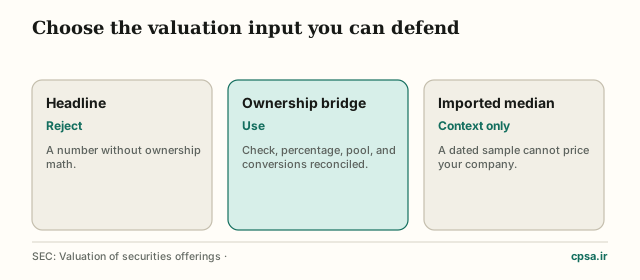
Use revenue multiples, a discounted cash-flow model, or comparable financings only when the inputs are observable and dated. Carta reports distributions from its US customer data; those observations describe that sample and period, not a universal price for a company in Tehran, Dubai, or Berlin.
Write a range tied to scenarios: cash needed, ownership sold, milestones funded, and the next-round dilution if the plan misses. The decision is whether the resulting ownership and runway are acceptable, not whether a spreadsheet can produce a larger number.
Jurisdiction and instrument limits
The SEC explains that valuation affects how many securities an issuer offers, but US securities exemptions still govern the offer and sale. A valuation calculation does not replace disclosure, board approval, exemption analysis, tax valuation, or local corporate-law steps.
YC post-money SAFE mechanics and NVCA priced-round documents assume US corporate machinery. In Iran, the UAE, or another jurisdiction, local counsel and tax advisers must map share classes, foreign ownership, currency, registration, and enforceability. This page is a calculation guide, not legal, tax, or investment advice.
Frequently asked questions
Is pre-money the company value before the round?
It is the negotiated equity value immediately before the new cash in that financing, not an independent appraisal.
How do I calculate pre-money from ownership?
Post-money = investment / post-close ownership; pre-money = post-money - investment.
Does an option-pool increase change dilution?
Yes. If included pre-money, existing holders usually absorb it. Model the fully diluted denominator.
Can I import a Carta median into my valuation?
No. Use dated sample data as context only and price your actual terms, jurisdiction, and risks.
Answers to the questions this topic usually leaves hanging.
How we sourced this
Every statistic in Calculate Pre-Money Valuation Backward from Ownership is attributed. Where a number is an estimate rather than a census, the note says so.
- SEC: Valuation of securities offeringsOfficial small-business explanation of valuation in an offering.
- Y Combinator SAFE documentsPost-money ownership mechanics and standard forms.
- NVCA model legal documentsPriced financing documents and capitalization definitions.
- Carta State of Private Markets Q3 2025Dated US sample context; not used as a universal benchmark.
Primary sources used for this edition.
The bottom line
If the ownership schedule does not reconcile, the pre-money headline is unfinished.
If you want the adjacent decisions after Calculate Pre-Money Valuation Backward from Ownership, start with Structure the cap table, Negotiate the term sheet, SAFE mechanics, Funding rounds.