A cap table is not a percentage spreadsheet. It is the transaction index connecting every holder and security to an issuance date, instrument, board or shareholder approval, vesting status, and fully diluted ownership result. The next investor will test whether that index reconciles to signed documents and the legal share ledger.
Start with the legal ledger
Create one row for every issuance, grant, transfer, cancellation, repurchase, warrant, SAFE, note, and promised equity award. Record the holder's legal name, security class, quantity, issue date, price, vesting, certificate or electronic ledger reference, and the approving consent. Percentages are calculated outputs, never source records.
Reconcile the table to charter-authorized shares and the official register before adding forecasts. A spreadsheet that shows 12 million issued shares when the charter authorizes 10 million is not approximately right; it exposes an approval or validity problem for counsel to resolve.
Keep three ownership views
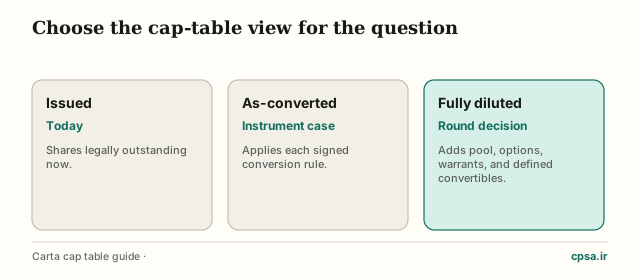
Maintain issued-and-outstanding, as-converted, and fully diluted views. Issued-and-outstanding answers who owns shares today. As-converted applies conversion terms. Fully diluted also includes granted options, the unallocated pool, warrants, and other securities included by the financing definition.
Do not collapse those views into one percentage column. YC post-money SAFEs make ownership modeling more transparent, but multiple caps, discounts, MFN terms, and a priced round still require instrument-by-instrument conversion. Attach each formula to the signed instrument that authorizes it.
Worked example: model the pool before price
Illustrative example, not a benchmark: founders hold 8 million shares and advisers hold 250,000. The company reserves 1 million option shares before financing, producing 9.25 million pre-money fully diluted shares. A new investor buying 20% post-close receives 2.3125 million shares, because new shares equal 20% / 80% times the pre-money fully diluted amount.
Run the same schedule with the pool expansion after financing and compare founder ownership. The economic negotiation is who absorbs the unissued pool, not whether the pool appears in a separate tab. Flag every number here as an example and replace it only with board-approved company records.
- Founders8 count
- Option pool1 count
- New investor2.313 count
- Advisers0.25 count
NVCA Yearbook (worked example). Illustrative millions of shares; not a market benchmark.
Close the jurisdiction gap
Carta software and NVCA forms support US venture workflows, but the legal register, required approvals, beneficial-ownership records, securities filings, and employee-equity tax treatment depend on the issuer's jurisdiction. SEC Form D is a US notice filing for specified exempt offerings; it is not an approval and does not travel to another country.
For an Iranian, UAE, UK, or other company, have local counsel identify which register controls and whether options, preferred rights, electronic signatures, foreign holders, or convertible instruments are recognized as modeled. Keep the operating cap table as a translation layer, never as a substitute for the controlling record.
Frequently asked questions
What belongs on a financing-ready cap table?
Every holder, security, issuance date, approval, vesting term, and conversion rule, linked to its document.
Should percentages be typed manually?
No. Calculate them from share quantities under named issued, as-converted, and fully diluted denominators.
Does an unallocated option pool dilute founders?
Economically yes when the financing definition includes it pre-money. Model who absorbs the pool.
Is Carta the legal share register?
That depends on jurisdiction and configuration. Reconcile any platform to the legally controlling register and approvals.
Answers to the questions this topic usually leaves hanging.
How we sourced this
Every statistic in Build the Cap Table the Next Round Can Reconcile is attributed. Where a number is an estimate rather than a census, the note says so.
- Carta cap table guideOperational cap-table structure and fully diluted ownership context.
- NVCA model legal documentsUS venture financing definitions, approvals, and capitalization schedules.
- Y Combinator SAFE documentsPost-money SAFE capitalization and conversion mechanics.
- SEC Form D notice filingOfficial scope and filing limits for US exempt offerings.
Primary sources used for this edition.
The bottom line
If a percentage cannot be traced to an issuance and approval, it is not ready for diligence.
If you want the adjacent decisions after Build the Cap Table the Next Round Can Reconcile, start with Calculate pre-money, Investment diligence, SAFE agreements, Term sheet tactics.