The right finance team is not a sequence of job titles. It is a coverage model for transaction processing, close, tax, payroll, cash, analysis, controls, and strategic decisions.
Map work, decisions, and risk
List recurring activities by frequency, deadline, volume, judgment, data sensitivity, and failure impact. Separate bookkeeping from accounting policy, treasury execution from cash approval, and model preparation from strategic decision.
Create a responsibility matrix naming preparer, reviewer, approver, backup, evidence, system access, and escalation. COSO controls apply to the complete process regardless of the employer named on a worker's contract.
Choose sourcing by control needs
Outsource standardized, documentable work when service levels, data access, review, and exit are controllable. Keep high-context decisions, bank authority, policy ownership, and vendor oversight with named internal leaders.
Perform due diligence on competence, references, staffing continuity, subcontractors, location, security, insurance, incident response, audit rights, data return, and deletion. A SOC report can inform controls but its scope, period, exceptions, and user-entity controls must be read.
Calculate capacity and coverage
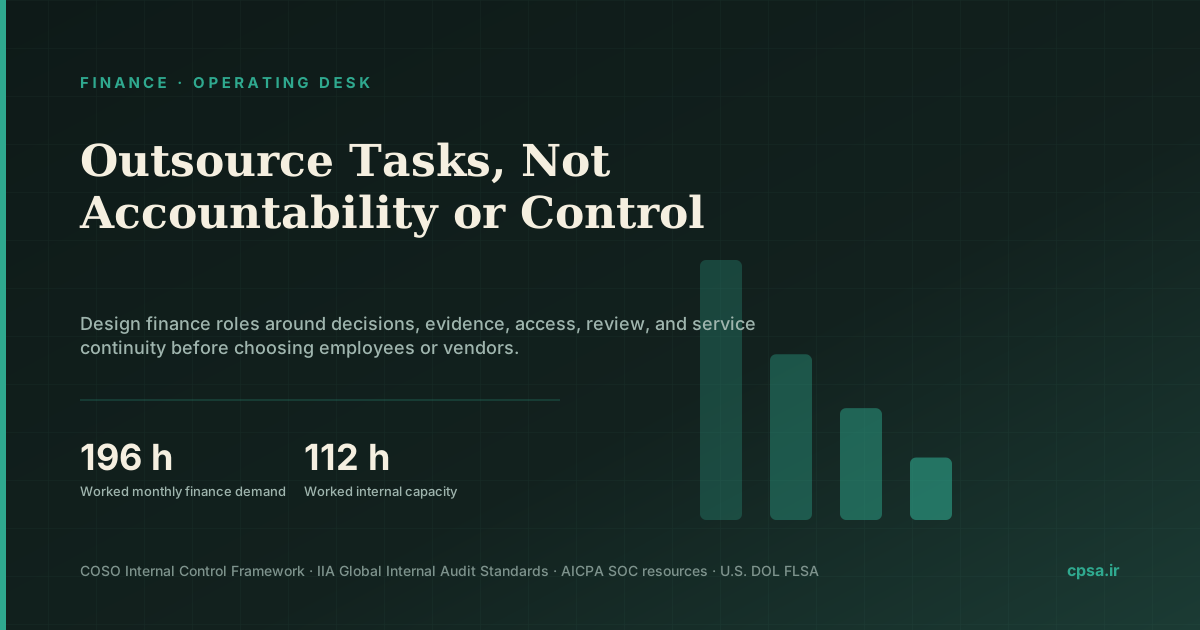
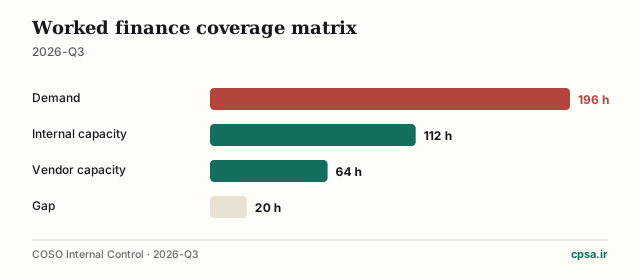
Illustrative Q3 2026 month: documented finance demand is 196 hours, internal available capacity 112, and contracted vendor capacity 64, leaving a 20-hour gap. This is a workload case, not a recommended staffing ratio.
Assumptions: hours exclude founder interruptions, close quality is acceptable, vendor hours are actually available, and work is measured in local contract currency with dated USD equivalents only for cost comparison. Labor classification, payroll, privacy, licensing, and permanent-establishment rules vary regionally.
- Demand196 h
- Internal capacity112 h
- Vendor capacity64 h
- Gap20 h
COSO Internal Control (2026-Q3). Illustrative monthly capacity worksheet; not market staffing data.
Govern performance and exit
Track close timeliness, unreconciled items, payment exceptions, filing status, evidence completeness, forecast accuracy, and unresolved decisions. Review outcomes and control failures, not hours billed alone.
Sensitivity: a 25% close-month demand increase raises demand to 245 hours and the gap to 69. Cross-train backups, preserve procedure and credential inventories, test data export, and rehearse transition so terminating a vendor does not stop payroll or reporting.
Frequently asked questions
When should a startup hire a CFO?
When financing, risk, complexity, and recurring decisions require sustained senior judgment—not at a universal revenue threshold.
Can the bookkeeper approve payments?
Preparation and release should be separated; unavoidable overlap needs documented compensating review.
Does a SOC report prove a vendor is safe?
No. Review scope, period, exceptions, subservice providers, and required customer controls.
How should contractor classification be handled?
Apply the law of each relevant jurisdiction to actual control and working facts; labels are insufficient.
Answers to the questions this topic usually leaves hanging.
How we sourced this
Every statistic in Outsource Tasks, Not Accountability or Control is attributed. Where a number is an estimate rather than a census, the note says so.
- COSO Internal Control FrameworkControl environment, activities, information, and monitoring.
- IIA Global Internal Audit StandardsIndependence, competence, evidence, and oversight.
- AICPA SOC resourcesAuthoritative service-organization control context.
- U.S. DOL FLSAOfficial U.S. wage and employment-status context.
Primary sources used for this edition.
The bottom line
Map next month's finance work to a preparer, reviewer, approver, backup, and evidence.
If you want the adjacent decisions after Outsource Tasks, Not Accountability or Control, start with Financial controls, Hiring, Financial Technology Stack for Startups, Financial Vendor Management for Startups.