A finance stack is an information-and-control architecture. More applications can increase automation while also multiplying identities, duplicated records, brittle mappings, and vendors that can interrupt close or payroll.
Start with objects and systems of record
Map customer, contract, invoice, payment, vendor, employee, expense, bank transaction, exchange rate, journal, and report. Name one authoritative source for each field and define which system may create, update, approve, and archive it.
Choose tools after requirements for entities, currencies, tax, consolidation, audit trail, local banking, data residency, language, volume, and close are known. A globally popular product may lack a required local invoice, bank rail, or export.
Engineer identity and integration controls
Use individual identities, single sign-on where supported, multifactor authentication, least privilege, maker-checker approval, periodic access review, and immediate offboarding. Service accounts need owners, scoped permissions, secret rotation, and monitored use.
For every API or file transfer, document fields, direction, frequency, error queue, idempotency, timezone, currency, retry behavior, alert, and reconciliation. OWASP verification practices help secure custom interfaces; they do not validate accounting semantics.
Work the architecture and cost case
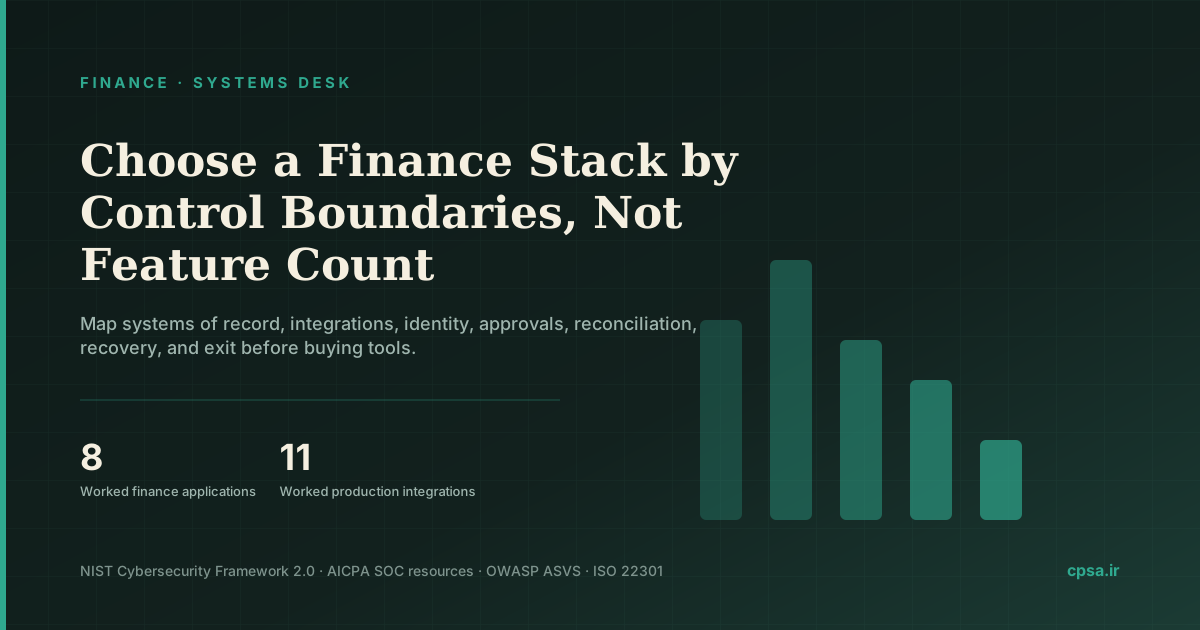
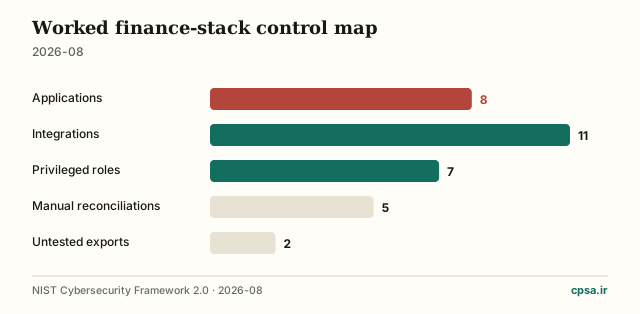
Illustrative August 2026 stack has eight applications, eleven production integrations, seven privileged roles, five manual boundary reconciliations, and two untested exports. Licenses plus support cost nominal USD 6,840 monthly; these are design inputs, not a startup benchmark.
Assumptions: implementation labor is excluded, prices are before tax, one reporting currency is USD, transaction currencies and dated rates remain stored, and all vendors serve the relevant jurisdictions. Add local tax, inflation, sanctions, connectivity, residency, and convertibility constraints before procurement.
- Applications8 count
- Integrations11 count
- Privileged roles7 count
- Manual reconciliations5 count
- Untested exports2 count
NIST Cybersecurity Framework 2.0 (2026-08). Illustrative architecture counts; not a maturity benchmark.
Test resilience and total cost
Back up configurations and critical exports, define recovery objectives, test restore, rehearse manual payroll and payment contingencies, and record vendor outage contacts. ISO 22301 supports continuity discipline; recovery must still be tested on the actual stack.
Sensitivity: a 20% license increase lifts monthly cost to USD 8,208; adding 80 implementation hours at an explicitly assumed USD 75 raises first-year cost by USD 6,000. Compare three-year cost, control coverage, switching effort, and concentration risk—not subscription price alone.
Frequently asked questions
Should one platform run all finance?
Only if it meets object, control, jurisdiction, resilience, and export requirements; consolidation can also increase concentration risk.
Are APIs better than files?
Not inherently. Reliability depends on schema, controls, monitoring, reconciliation, and recovery.
Does SOC 2 approve a product?
No. Read the report's scope, period, opinion, exceptions, subservices, and customer controls.
How often should access be reviewed?
At a risk-based cadence and immediately after role, employment, vendor, or incident changes.
Answers to the questions this topic usually leaves hanging.
How we sourced this
Every statistic in Choose a Finance Stack by Control Boundaries, Not Feature Count is attributed. Where a number is an estimate rather than a census, the note says so.
- NIST Cybersecurity Framework 2.0Governance, protection, detection, response, and recovery.
- AICPA SOC resourcesAuthoritative context for service-provider controls.
- OWASP ASVSApplication and integration security verification requirements.
- ISO 22301Business-continuity management requirements.
Primary sources used for this edition.
The bottom line
Name the authoritative system and reconciliation for every material financial object.
If you want the adjacent decisions after Choose a Finance Stack by Control Boundaries, Not Feature Count, start with Financial analytics, Financial controls, Financial Vendor Management for Startups, From Employee to Entrepreneur.