Market-size slides fail because they start at the country and divide. Start at a buyer who already spends, multiply by a price they already pay, then subtract everyone you cannot reach and everyone you will not close this year. BLS closure rates are what happens to businesses whose obtainable market was a slogan.
TAM is current substitute spend
List buyers who already pay to make the pain go away. Multiply by what they pay the current vendor. That product is TAM. A population times a wish is not.
The substitute may be labor, delay, loss, or another product, but its price must be observable and the buyers must not be counted twice. If different segments pay different prices, calculate each segment separately before adding them.
SAM is reach, not ambition
Subtract buyers you cannot legally sell to, cannot support, or cannot speak to. Language, license, and payment rails are SAM filters. Iran-to-US payments are a SAM cut, not a motivational quote.
Reach is product-specific and time-specific. A buyer inside the geography but requiring an integration, certification, or service language you do not provide is outside today’s SAM even if a future roadmap could include them.
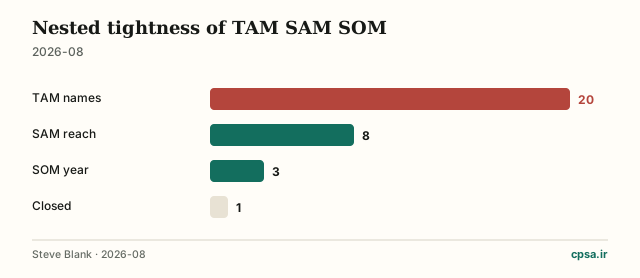
- TAM names20 count
- SAM reach8 count
- SOM year3 count
- Closed1 count
Steve Blank (2026-08). Relative tightness of the three questions — a labeled illustration, not a census or a BLS table.
SOM is this year’s motion
Obtainable market is the spend you can close in twelve months with the sales motion you actually have. If you have one founder selling, SOM is not 1% of TAM. It is the number of first meetings times close rate times price.
Capacity is a boundary as real as demand. Limit SOM by available sales conversations, implementation slots, and collection timing; signed demand that the team cannot onboard this year does not belong in this year’s obtainable market.
Worked clinic tool
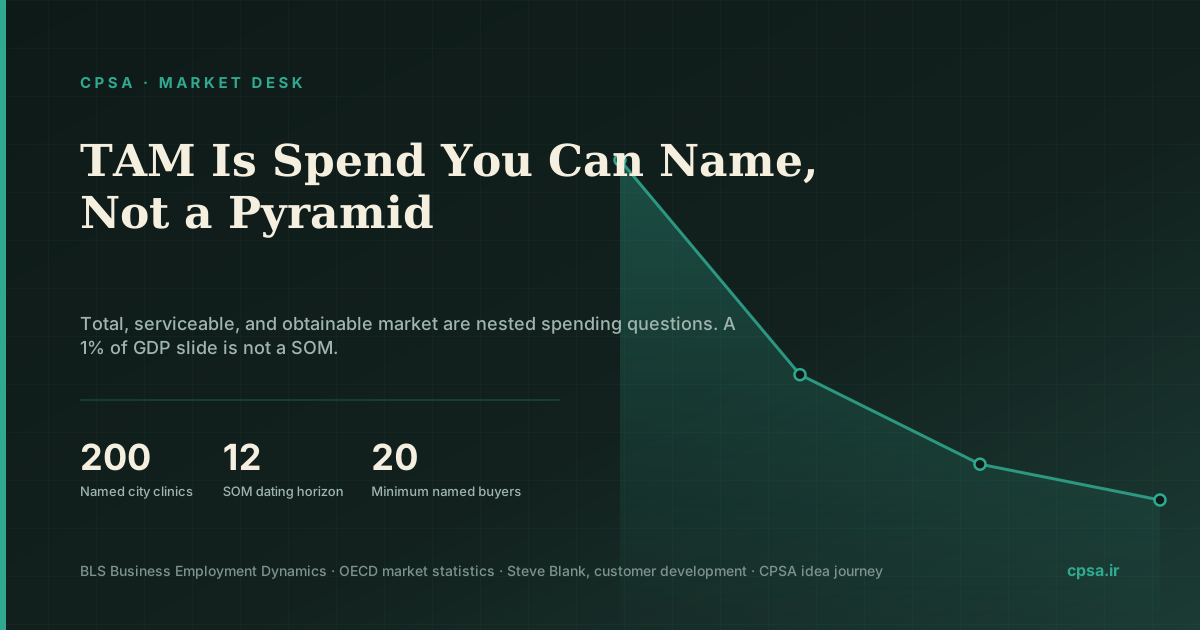
Labeled example: 200 clinics in a city already pay a secretary 15 million rial a month to call no-shows. TAM in that city is 3.0 billion rial a month if you replace that spend. SAM is the 80 clinics that will take a Farsi call. SOM is the 12 you can close this year.
A second observed pattern is a pharmacy tool whose buyers split between independent stores and chains. Their approval paths and substitute costs differ, so one national store count multiplied by one price would be false precision; size each segment, then cut SAM by integrations and SOM by reachable decision makers.
When a top-down number is allowed
Use a government or industry census only to check that your bottom-up TAM is not larger than the official spend. If it is, you double-counted or invented buyers.
A top-down total can also reveal missing segments, but it cannot assign your price, reach, or close rate. Treat disagreement as an audit prompt—definitions, year, geography, and double counting—not as permission to choose the larger slide number.
Frequently asked questions
Can I show TAM as 1% of GDP?
No. That is a slogan. Name buyers and substitute prices.
How is SOM different from a forecast?
SOM is the market you can reach this year. A forecast is what you claim you will close. They should be the same meeting.
Do BLS numbers size my market?
No. They remind you that slogan markets die in year one. They are a US backdrop, not a clinic count.
What if I am creating a new spend?
Your TAM is still a substitute: time, another vendor, or a budget line you will steal. If there is no substitute, you are pre-market.
Answers to the questions this topic usually leaves hanging.
How we sourced this
Every statistic in TAM Is Spend You Can Name, Not a Pyramid is attributed. Where a number is an estimate rather than a census, the note says so.
- BLS Business Employment DynamicsYear-one US closure as the cost of slogan markets — backdrop, not a TAM.
- OECD market statisticsOfficial spend checks for top-down sanity.
- Steve Blank, customer developmentBuyer conversations before market slides.
- CPSA idea journeyFirst-week spender test adjacent to sizing.
Primary sources used for this edition.
The bottom line
Write twenty named buyers before you draw a pyramid.
If you want the adjacent decisions after TAM Is Spend You Can Name, Not a Pyramid, start with Where to begin, Market validation, Feasibility, Unit economics.