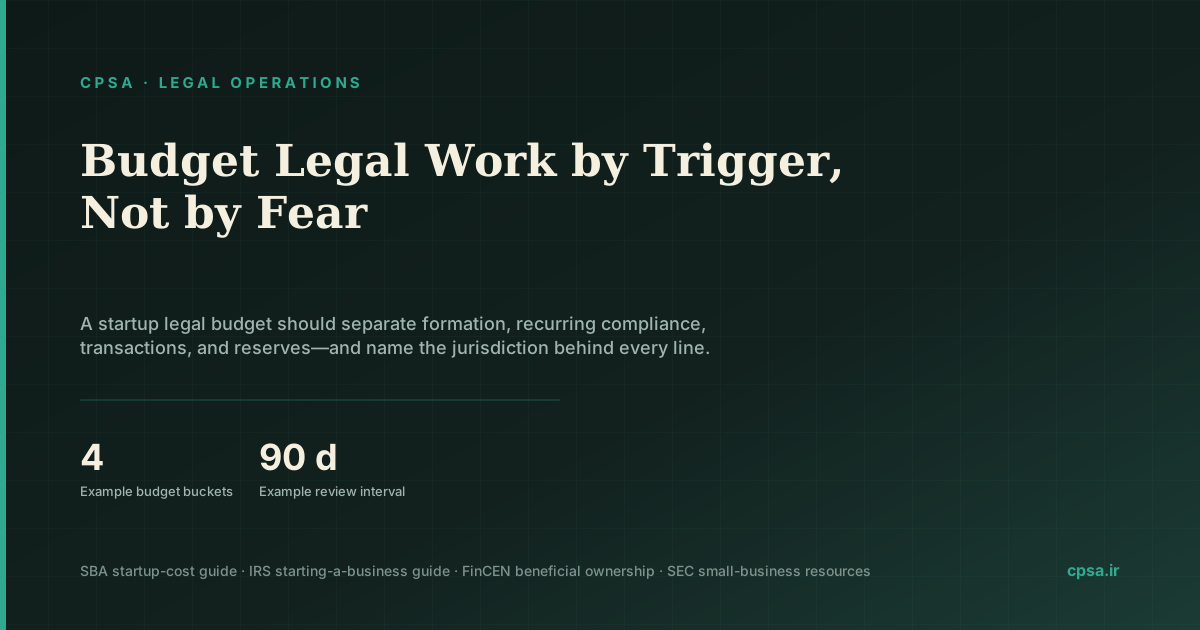
Legal spend is not one annual number. Formation fees are fixed by the chosen registry; tax and reporting recur; financing and hiring appear when transactions occur; disputes arrive without permission. This research factory turns those different clocks into a twelve-month operating budget without pretending that example amounts are market benchmarks.
Start with jurisdiction and entity
Registry fees, annual filings, tax registrations, and beneficial-ownership duties belong to a specific entity in a specific place. Record the legal name, governing law, operating locations, and filing authorities before asking for a quote. A Delaware corporation, a UAE free-zone company, and an Iranian private joint-stock company do not share one fee calendar.
Use official fee and filing pages as the dated baseline, then ask locally qualified counsel which obligations apply. FinCEN’s beneficial-ownership rules illustrate why a line can change after formation; its current page must be checked on the review date rather than copied from an old checklist.
Separate fixed, recurring, and triggered work
Put formation and registered-agent costs in the fixed bucket; tax returns, licenses, privacy reviews, and board housekeeping in recurring work; financings, major contracts, hiring in a new country, and disputes in triggered work. The distinction prevents a seed round from consuming the compliance money due next month.
For each line, write the trigger and the evidence that closes it: filed receipt, signed agreement, advice note, or board approval. The budget then measures completed legal operations rather than hours purchased.
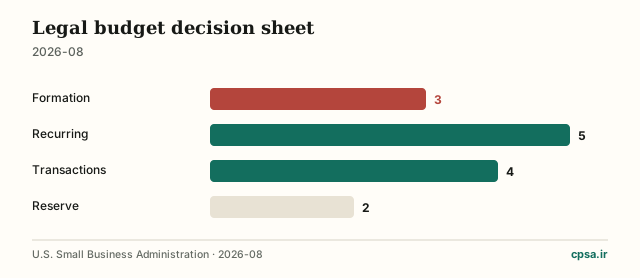
- Formation3 count
- Recurring5 count
- Transactions4 count
- Reserve2 count
U.S. Small Business Administration (2026-08). Example review questions per bucket; a planning artifact, not observed spending.
Build the twelve-month decision sheet
The useful artifact is one sheet with columns for entity, jurisdiction, matter, trigger, due date, estimated range, reserve, approver, and closing evidence. Keep assumptions beside each estimate and label founder-created scenarios as examples. Do not publish an uncited hourly rate as an industry benchmark.
Review the sheet before a financing, market entry, first hire in a country, material data-processing change, or contract above the approval threshold. A quarterly review is only the example cadence used here; the actual frequency follows the company’s transactions and filing calendar.
Control scope before instructing counsel
Send counsel the decision required, facts already verified, documents available, jurisdictions involved, deadline, and requested output. Ask which assumptions would change the scope. A bounded question is easier to price and less likely to produce a memo nobody can operate.
Do not cap fees by silently deleting necessary local review. If the budget is insufficient, narrow the transaction, defer it, or request staged advice with explicit stop points. Record who accepted the residual risk.
Effective-date and advice boundary
Authorities and links were reviewed on 21 August 2026. Filing duties, exemptions, government fees, and professional rates can change sooner; re-check the official source on the payment or filing date.
This planning model is not legal, tax, or accounting advice and does not estimate the cost of a specific matter. Qualified counsel in each governing and operating jurisdiction must determine scope and required filings.
Frequently asked questions
What belongs in a startup legal budget?
Formation, recurring filings, transaction work, and a clearly labeled reserve, each tied to a jurisdiction.
Is 15% the right contingency?
No universal percentage exists here. Fifteen percent is a labeled scenario input, not a benchmark or recommendation.
How often should the budget be reviewed?
At each material trigger and on the entity’s filing calendar; 90 days is only this artifact’s example cadence.
Can software replace counsel review?
No. It can track dates and approvals; qualified local counsel determines legal scope.
Answers to the questions this topic usually leaves hanging.
How we sourced this
Every statistic in Budget Legal Work by Trigger, Not by Fear is attributed. Where a number is an estimate rather than a census, the note says so.
- SBA startup-cost guideOfficial planning categories for one-time and monthly startup costs.
- IRS starting-a-business guideFederal tax and recordkeeping entry points.
- FinCEN beneficial ownershipCurrent US beneficial-ownership reporting status.
- SEC small-business resourcesOfficial securities-law resources for capital raising.
Primary sources used for this edition.
The bottom line
If a legal line has no trigger, owner, jurisdiction, or closing evidence, it is not ready for the budget.
If you want the adjacent decisions after Budget Legal Work by Trigger, Not by Fear, start with Legal documentation, Legal risk, Legal structure, Legal technology.