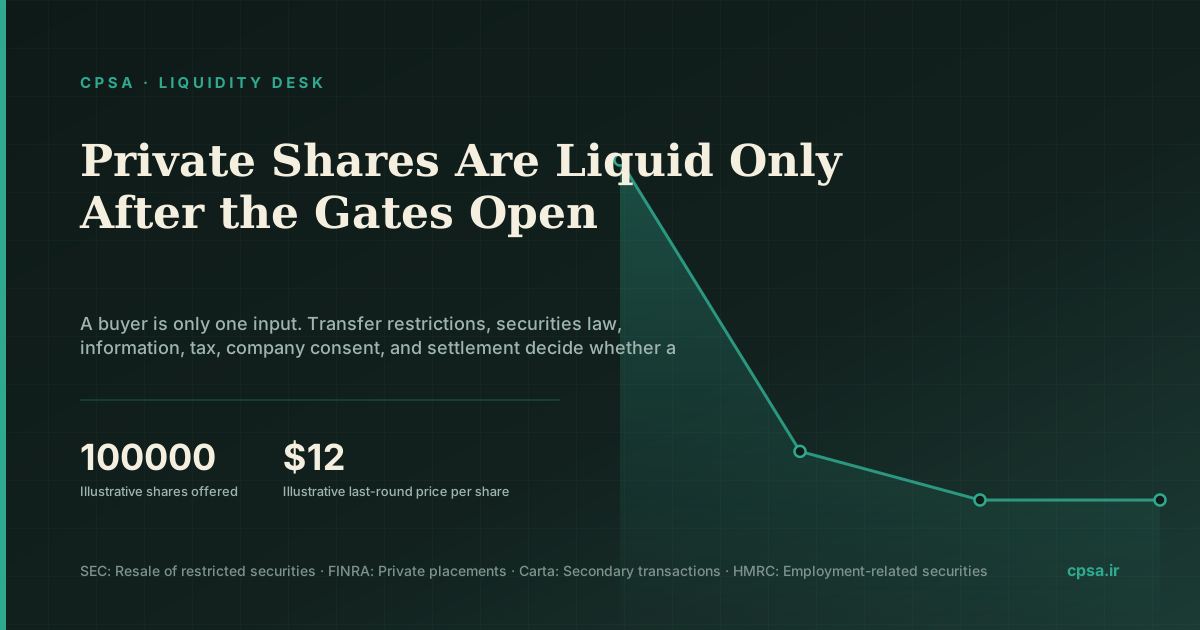
A startup investor cannot create liquidity by finding a price alone. The charter, shareholder agreement, right of first refusal, co-sale rights, board approvals, securities exemptions, buyer diligence, tax, sanctions, currency controls, and settlement mechanics may each stop the transfer. Treat liquidity as a gated closing process.
Map the transfer gates first
Read the charter, bylaws, shareholder agreement, investor rights, voting agreement, equity plan, grant documents, and cap table. Identify prohibitions, company or investor consent, right of first refusal, co-sale, drag, lock-up, legends, and repurchase rights. A signed purchase agreement cannot cure a transfer the governing documents prohibit.
Then map securities-law status, seller and buyer eligibility, holding period, required disclosure, broker or platform role, beneficial-ownership reporting, sanctions, foreign ownership, and currency transfer. SEC resale routes are US-specific; they do not authorize a sale governed elsewhere.
Compare four liquidity routes
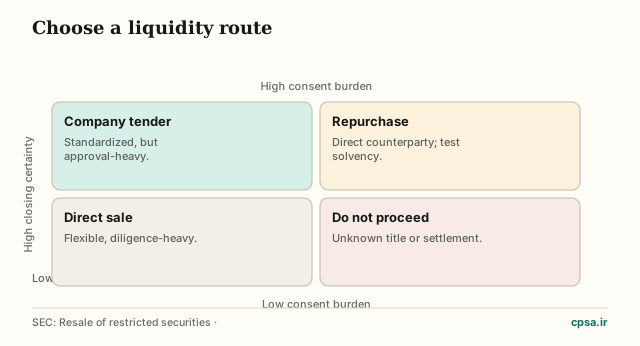
A direct bilateral sale can be targeted but carries price discovery, diligence, and consent friction. A company-sponsored tender standardizes price and documents across a defined population. A company repurchase can simplify the counterparty but consumes corporate cash and requires solvency and approval analysis. A structured vehicle may aggregate buyers but adds fees, governance, and beneficial-owner complexity.
Use one scorecard: eligible sellers, maximum volume, price-setting method, information package, required consents, fees, tax withholding, closing conditions, settlement rail, and failed-close allocation. Mark unknowns as blockers rather than giving them a neutral score.
Worked proceeds are not headline price
Illustrative example, not a benchmark: 100,000 shares had a $12 last-round reference price, but a buyer offers $9. Gross proceeds are $900,000, not $1.2 million. After an illustrative $50,000 reserve for legal, platform, and settlement costs, cash before tax is $850,000.
Do not infer the discount is 25% economic loss without checking preference, share class, information rights, time elapsed, company performance, and probability of closing. Do not calculate after-tax proceeds until holder residence, acquisition basis, employment connection, currency, and transaction date are known.
- Last-round reference1,200 $k
- Secondary gross900 $k
- After costs850 $k
- Cash before tax850 $k
Carta liquidity (worked example). Illustrative proceeds waterfall; taxes are excluded because jurisdiction and holder status control them.
Set a go/no-go closing memo
Proceed only when title is verified, the cap table reconciles, waivers and consents are dated, the buyer's eligibility is documented, disclosure is approved, funds and settlement instructions are verified independently, and tax withholding responsibility is assigned. Include a long-stop date and return-of-funds mechanism.
US, UK, UAE, Iranian, EU, and free-zone rules differ on resale exemptions, company repurchases, employee-related shares, tax, sanctions, and registration. Qualified counsel and tax advisers in every relevant jurisdiction must approve the route. This page is not legal, tax, or investment advice.
Frequently asked questions
Can an investor sell private shares at any time?
Usually not. Contractual restrictions, company consent, securities law, and settlement conditions may block the transfer.
Is the last round price the secondary price?
No. It is a dated reference for a possibly different security, rights package, and market condition.
Which route gives the best liquidity?
The route with the highest risk-adjusted net proceeds and closing certainty, not necessarily the highest quote.
Can a platform remove legal review?
No. Platform process does not replace issuer documents, exemptions, tax analysis, or local counsel.
Answers to the questions this topic usually leaves hanging.
How we sourced this
Every statistic in Private Shares Are Liquid Only After the Gates Open is attributed. Where a number is an estimate rather than a census, the note says so.
- SEC: Resale of restricted securitiesOfficial US resale pathways and restrictions.
- FINRA: Private placementsInvestor risks, illiquidity, and information limits.
- Carta: Secondary transactionsOperational overview of tenders and direct secondaries.
- HMRC: Employment-related securitiesUK tax context for employee-linked shares.
Primary sources used for this edition.
The bottom line
If title, consent, exemption, and settlement are not all green, the shares are not liquid yet.
If you want the adjacent decisions after Private Shares Are Liquid Only After the Gates Open, start with Investment documents, Term sheets, Risk management, Cap tables.