Exit planning is not choosing an acquisition year in a spreadsheet. It is preserving the company’s ability to continue independently, sell cleanly, recapitalize, or wind down without one hidden consent, founder dependency or ownership dispute destroying the choice.
Write buyer theses, not buyer wishes
Describe why a class of buyer could create more value than the company alone: product adjacency, distribution access, proprietary capability, regulated license, supply assurance or talent. Then list the evidence and disconfirming condition. A logo list without a value-creation mechanism is not an exit strategy.
The labeled example keeps three theses—product, channel and capability—to force distinct evidence. Three is not a benchmark. A sanctions-sensitive cross-border business may have one lawful buyer class; a horizontal software tool may have several. Validate interest through ordinary partnerships and customer behavior without manufacturing a sale process.
- Financial records5 score
- Customer contracts4 score
- IP ownership3 score
- Management transfer2 score
- Regulatory approvals1 score
SEC M&A investor bulletin (labeled example). Illustrative readiness scores; no score predicts an exit.
Make operations transferable
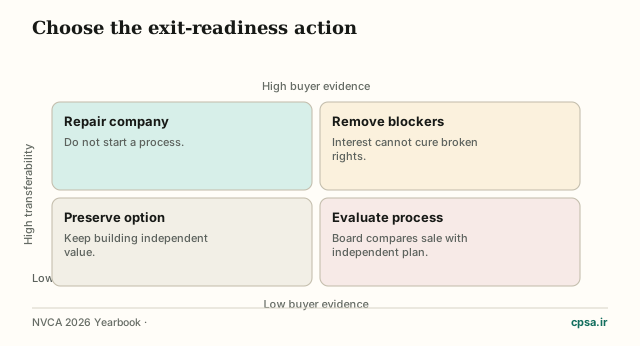
Map what fails if founders leave for ninety days: signing authority, customer trust, pricing, source-code access, vendor relationships, regulatory contacts and incident response. Assign successors, document approvals, test access recovery and move personal accounts into controlled company systems.
Audit transfer restrictions in customer, supplier, debt, license, employment and IP agreements. Confirm invention assignments, option grants, board approvals, tax records and beneficial ownership. In the worked audit, five gaps are simply findings to close; they are not a normal number or proof that a transaction will complete.
Model proceeds and failure paths
Build a security-by-security waterfall for multiple gross values, then subtract debt, transaction expenses, escrows, holdbacks, taxes and liabilities before allocating cash. Include preference, participation, conversion, vesting, option treatment and earn-out uncertainty exactly as documented.
A $12 million gross exit is a labeled example, not a valuation forecast. Use it to ask who receives what if the deal closes late, consideration is partly contingent, or a preference class chooses not to convert. Also model no sale: default-alive operation, recapitalization and orderly wind-down.
Gate outreach through law and timing
Board authority, fiduciary duties, shareholder approvals, information control, competition review, foreign-investment screening, sanctions, tax and employee consultation can alter or prevent a transaction. FTC premerger material and DOJ/FTC merger guidelines concern US law; thresholds, procedures and enforcement change over time.
NVCA’s 2025 deal population is not an exit-rate denominator and cannot predict time to liquidity. Iran, UAE, UK, EU, Canada and other jurisdictions differ materially; cross-border transfers may add exchange-control and sanctions constraints. Qualified M&A, competition, tax and local counsel must advise the actual process.
Frequently asked questions
When should exit planning begin?
When the company first creates rights, dependencies or records another owner would need to transfer.
Should founders contact acquirers early?
Build legitimate commercial relationships; coordinate any sale outreach with the board and counsel.
Is a high gross offer a good exit?
Not necessarily. Model net, timing, certainty, consideration form, liabilities and stakeholder allocation.
Can market deal counts predict my exit?
No. The relevant population, financing path, buyer thesis and legal constraints are company-specific.
Answers to the questions this topic usually leaves hanging.
How we sourced this
Every statistic in Plan an Exit by Preserving Strategic Options is attributed. Where a number is an estimate rather than a census, the note says so.
- NVCA 2026 YearbookUS venture market population context.
- SEC mergers and acquisitions glossaryOfficial US investor context for transaction forms.
- FTC Premerger Notification ProgramOfficial US merger-review process.
- 2023 Merger GuidelinesUS DOJ/FTC competition-analysis framework.
Primary sources used for this edition.
The bottom line
The long game is a company that can transfer cleanly but does not need to sell to survive.
If you want the adjacent decisions after Plan an Exit by Preserving Strategic Options, start with Term-sheet tactics, Cap table planning, Portfolio monitoring, Legal risk.