Investor diligence is not the collection of every available document. It is a designed attempt to disprove the few claims that make the investment attractive, while checking that ownership, authority, cash, obligations and compliance can support the proposed security.
Start with the return-bearing claims
Reduce the thesis to claims that can fail: the buyer has an urgent budget, retained use persists, acquisition can repeat at an affordable cost, and the product can be delivered without an unpriced legal or technical liability. For each claim write the decisive contrary observation before requesting documents.
The worked scope uses four claims and twelve tests solely to show traceability. A regulated lender, biotech company or cross-border marketplace may need more workstreams; a small follow-on may need fewer. Scope follows materiality, novelty, mandate and the security—not an inherited checklist length.
- Corporate and cap table5 count
- Revenue and cash4 count
- Customers and market3 count
- Product and security2 count
SEC private funds (labeled example). Illustrative verified tests by workstream; not an industry completion benchmark.
Trace summaries to primary records
Reconcile management accounts to bank activity, invoices, contracts, tax filings and the general ledger. Reconcile the cap table to charter, board and shareholder approvals, security instruments, transfer records and option grants. Sample revenue by risk, not convenience: concentration, side letters, refunds, related parties and unusual period-end entries.
Customer calls need consent, a stable script and selection-bias disclosure. Ask what was bought, who approved, implementation time, actual use, alternatives, renewal conditions and failures. A hand-picked advocate verifies one account, not the customer population; connect every quote to contract and product telemetry where lawful.
Turn technical review into business exposure
Inspect architecture, dependency ownership, release controls, incident history, recovery tests, data map, privileged access, security obligations and the people required to operate the system. NIST CSF 2.0 supplies a risk vocabulary; it does not certify a startup or prescribe one universal diligence test.
Translate each finding into probability range, cash exposure, customer impact, time to repair, owner and deal treatment. Unsupported encryption wording may require a contract correction; a failed restore test may require a closing condition; key-person concentration may change reserves and board reporting. Severity without a disposition is merely decoration.
Close every gap and state the limits
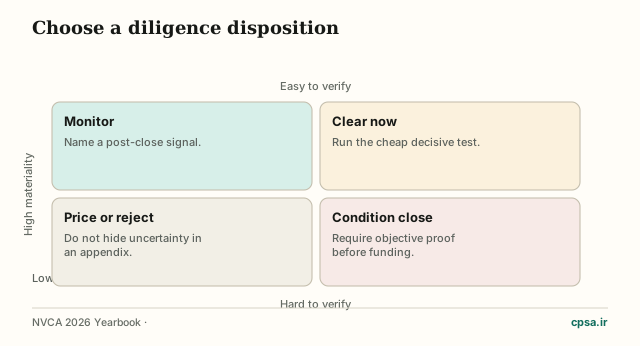
A gap has five possible destinations: disprove and reject, verify before close, price in economics, protect in documents, or monitor after close. In the labeled case, three material gaps must each receive an owner, deadline and destination. More data is not a disposition.
NVCA’s 2025 count describes reported US venture deals, not diligence success or fraud prevalence. SEC and FTC sources are US context; NIST is voluntary. Corporate, securities, privacy, employment, tax, sanctions and foreign-investment rules differ across jurisdictions. Specialists and local counsel must perform the actual review; this is not legal or investment advice.
Frequently asked questions
What should investors diligence first?
The claim whose failure destroys the return thesis and can be tested with primary evidence.
Is management’s data room enough?
No. Reconcile summaries to independent or primary records and disclose sampling limits.
Does a red flag always stop the deal?
No. Its materiality, verifiability and reversibility determine rejection, condition, price, protection or monitoring.
Can NIST certify security readiness?
No. CSF 2.0 is a voluntary risk-management framework, not a startup certification.
Answers to the questions this topic usually leaves hanging.
How we sourced this
Every statistic in Investment Due Diligence from the Investor’s Side is attributed. Where a number is an estimate rather than a census, the note says so.
- NVCA 2026 YearbookUS venture-deal population context.
- SEC private fundsOfficial US investor and private-fund context.
- NIST Cybersecurity Framework 2.0Voluntary technical risk-governance framework.
- FTC privacy and securityUS business guidance on data-security obligations.
Primary sources used for this edition.
The bottom line
The diligence file is finished when each material claim and gap has a decision consequence.
If you want the adjacent decisions after Investment Due Diligence from the Investor’s Side, start with Founder diligence checklist, IC presentations, IC decisions, Term-sheet tactics.