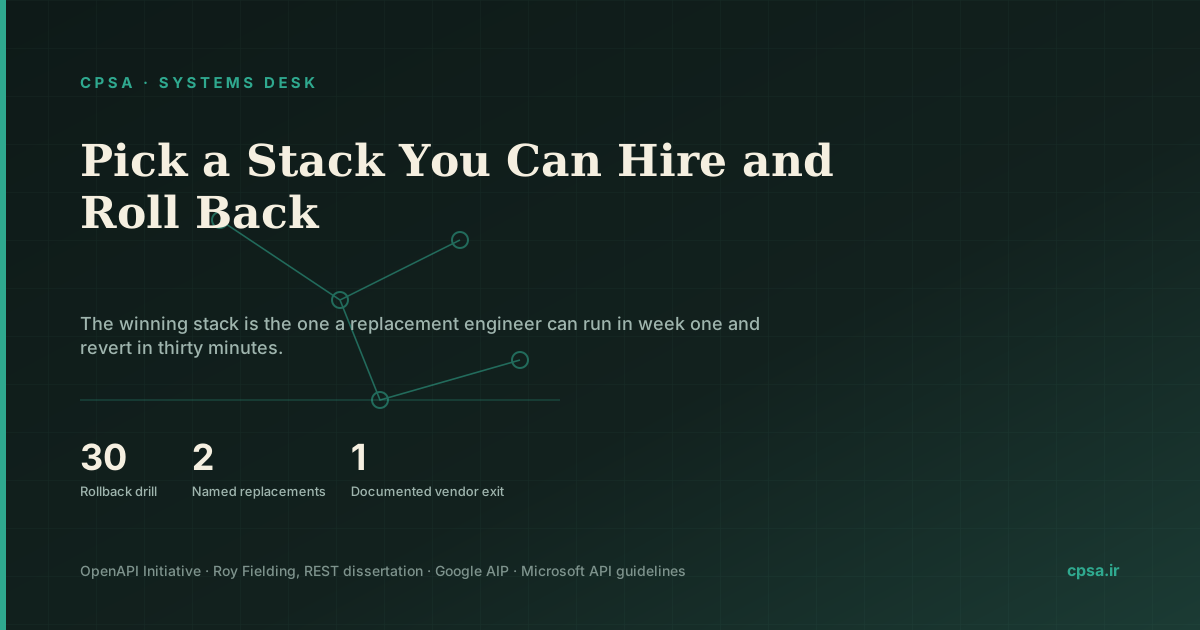
Stack debates are usually taste. The operating questions are narrower: can you hire a second person, can you leave the vendor, and can you undo last Tuesday? OpenAPI-era teams already know contracts matter more than frameworks. This page applies the same test to the whole stack.
Hiring depth beats novelty
If you cannot name two people in your city or remote circle who have shipped this stack, you have hired a museum. Prefer the language your next hire already knows unless the problem truly requires the other one.
Count production experience, not tutorial familiarity, and include operations in the test. A framework with many developers but no one willing to own its database, deployment, or incident path still has shallow hiring depth.
Vendors need an exit page
Write how you export data and what you replace the vendor with. Payment, SMS, and cloud accounts fail at the worst time. A Mashhad team that cannot change a payment vendor is not modern; it is stuck.
Test the export before choosing: format, completeness, rate limits, cost, credentials, and time to restore elsewhere. A contractual right to export is not an exit if the team has never proved the data can rebuild the service.
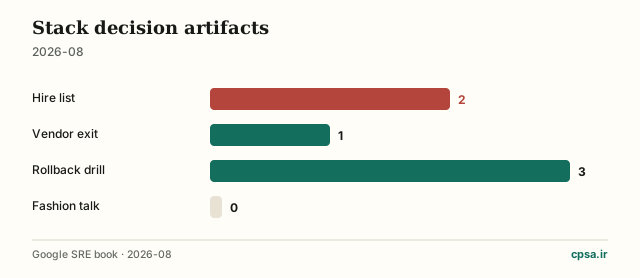
- Hire list2 count
- Vendor exit1 count
- Rollback drill3 count
- Fashion talk0 count
Google SRE book (2026-08). Labeled operator artifacts informed by SRE release engineering. Not an OpenAPI or SRE census.
Rollback is a drill
Thirty minutes to the last good version. If the only person who can do that is on a flight, the stack has already chosen your outage length. Keep last week’s contract — OpenAPI or otherwise — next to the runbook.
Include schema and configuration in the drill, not only application binaries. A release is not reversible when the old code cannot read the new data or when a vendor-side setting has no recorded prior value.
When novelty is allowed
A true constraint — hardware, latency, a regulator — can force a rare stack. Write the constraint on the same page as the repo. Fashion is not a constraint.
Run the rare component behind a narrow interface and state the condition that would remove it. If a common tool meets the measured constraint after a test, novelty has lost its exception and should not spread through the rest of the system.
Monolith first is a stack decision
A modular monolith with a reviewed API contract is usually cheaper than five services and four queues. Split when a team boundary is real, not when a talk said so.
The counterexample is a boundary with independent scaling, security, failure, or ownership needs that the monolith demonstrably cannot isolate. Even then, extract one measured boundary first; service count is not evidence of scalability.
Frequently asked questions
Should we use the language the founder likes?
Only if a replacement can be hired. Taste is not a staffing plan.
Is serverless automatically simpler?
It moves the vendor-exit problem. Write the exit page anyway.
How do we pick a cloud?
By region, payment, and export. Not by the sticker on a conference booth.
Does API-first pick the stack?
It picks the contract order. The language still has to pass hire and rollback.
Answers to the questions this topic usually leaves hanging.
How we sourced this
Every statistic in Pick a Stack You Can Hire and Roll Back is attributed. Where a number is an estimate rather than a census, the note says so.
- OpenAPI InitiativeContracts as the stable part of a stack.
- Roy Fielding, REST dissertationInterface constraints over implementation fashion.
- Google AIPCompatibility rules that outlive a framework.
- Microsoft API guidelinesVersioning discipline as a stack test.
- Google SRE release engineeringRollback as a required release-engineering drill, not a census of minutes.
Primary sources used for this edition.
The bottom line
If you cannot hire it or undo it, do not add it this quarter.
If you want the adjacent decisions after Pick a Stack You Can Hire and Roll Back, start with API-first, Architecture, DevOps, Hiring.